skip to main | skip to sidebar
Reflective Online Teaching
My Personal Site for Reflective Teaching
RSS
    Jonathan Acuña Solano, Post Author
    Contact Email: jonacuso@gmail.com

Best Practices for Designing Learning Competencies

Competency-Based Learning, Teaching Practices 0 comments


Best Practices for Designing Learning Competencies

By Prof. Jonathan Acuña Solano
Sunday, October 18, 2015
Twitter: @jonacuso
Post 196


“Quality learning competencies are important for successful competency based learning experiences. When first transitioning from a traditional model of learning to the competency based model of learning, designing quality competencies can often be a challenging task” (Laureate Education, Inc., 2013). To decrease the level of anxiety one may experiment with the designing of competencies, it is a good idea to follow some best practices in their development. Two of the suggested best practices by Laureate Education, Inc. experts (2013) are: 1) “Competencies should prepare learners for the next level” and 2) “Competencies should be aligned to learning objectives and assessments.”

“Competencies should prepare learners for the next level” (Laureate Education, Inc., 2013). Competencies are meant to aid the student to move to the next level of comprehension needed to progress in class, in higher studies, or while being at work. Within the class context of instruction, the development of competencies prepares learners to face the next piece of instruction they must master, which is meant to help them to be better prepared for their current or future working environment. In the long run, what pupils will be demonstrating is what skills they have acquired for themselves and for their performance in class, while getting a higher degree, or while having to use in their workplaces. The instructor then is meant to provide activities such as projects along with formative feedback to help learners develop their competencies.

“Competencies should be aligned to learning objectives and assessments” (Laureate Education, Inc., 2013). A competency is like the end product of instruction; that is, it is what learners get form one’s class to succeed in the real working world. Courses are designed and developed bearing in mind specific learning objectives in their course outlines. These objectives must be translated into measurable objectives that need to be tested while students demonstrate theory and practice comprehension.


As a literature professor at Universidad Latina in Costa Rica, these two best practices have a powerful impact in my hybrid/blended classes. From a mere constructivist learning stance, whatever is done prior the beginning of a new thematic unit helps build student understanding. Yet, whatever is being practiced with pupils and then demonstrated by them must be aligned with the learning goals stated in the course outline one is following. This is basically what I intend to do in my Literary Criticism class where prior knowledge becomes crucial in the creation on new knowledge in the mind of learners, who will transform these pieces of knowledge into literary analysis skills and competencies to be used in the understanding of poesies, narratives, and dramas.

Let us know pay attention to an example of literary criticism in action. Learners in this class are meant to comprehend that hermeneutics is not the only way to interpret literature. Students are explained that “literal interpretation asserts that a […] text is to be interpreted according to the ‘plain meaning’ conveyed by its grammatical construction and historical context” (Hermeneutics, n.d.). Then, students are confronted with other way of make meaning out of a literary text beyond the hermeneutical domain that simply allows you to come up with only one correct interpretation.

Antecedent – Behavior – Condition Competency Formulation
A = Using the Reader Response way of literary interpretation,
B = Learners will be able to analyze [a piece of poetry, drama or narrative]
C = correctly by providing their personal points of view in an essay

To ensure that a competency like the one stated above, certain steps must be followed. If it can be noticed, it a competency that is specific (Reader Response to literary analysis, clear (use of a Bloom’s taxonomy verbs such as analyze), and measurable (a given product is produced, being in this case an essay, and checked with a rubric). Students will also be able to apply their recently-acquired knowledge on Reader Response to solve a problem they are provided with, the understanding of a piece of literary creation, in which they have to apply their inner emotions, personal feelings, and life experiences, normally used by writers in their literary creation. Finally, a competency like this aims at working with any level of competency or learning preferences.

Referencias


Hermeneutics. (n.d.). Obtenido de Enclyclopaedia Britannica: http://www.britannica.com/topic/hermeneutics-principles-of-biblical-interpretation

Laureate Education, Inc. (2013). Best Practices for Designing Learning Competencies. Retrieved from Faculty Development: https://lnps.elearning.laureate.net/bbcswebdav/institution/


Sunday, October 18, 2015


Initial Thoughts on Competency-Based Learning

Competency-Based Learning 0 comments

Initial Thoughts on Competency-Based Learning

By Prof. Jonathan Acuña Solano
Monday, October 12, 2015
Twitter: @jonacuso
Post 195

          “The most important characteristic of competency-based education is that it measures learning rather than time. Students progress by demonstrating their competence, which means they prove that they have mastered the knowledge and skills (called competencies) required for a particular course, regardless of how long it takes” (Mendenhall, 2012). Based on Mendenhall’s characterization of Competency-Based Learning (CBL), I have been modifying my teaching in such a way that learners can demonstrate what they have been learning by means of projects, research tasks, and cooperative learning practices.

          At Universidad Latina in Costa Rica, I am certain that lots of Faculty Members do use CBL in class and in various subjects and programs, but I cannot for sure tell whether it is the vast majority. In language learning, which is my area of work and expertise, I have been developing all sorts of small-scale projects to foster the consolidation of knowledge and skills into competencies that learners can use at work. Several of my colleagues do work similarly to me, yet others are more traditional in their teaching. To have all Faculty Members at Universidad Latina hold on to CBL, all of us must bear in minad that, as stated by the College Affordability Guide, “competency-based education’s results-oriented format allows students to use prior learning, open educational resources and whatever learning methods work well for them, as long as they can prove mastery of the material” (Competency-Based Education: Why MOOCs and Independent Learning are Tomorrow’s Course Credits, n.d.). This will no doubt result in more deep learning for all our college students.

          My personal experiences with Competency-Based Learning has made me shift 180° in my teaching approach nowadays. As Everhart posits (2014), CBL is meant to be “learner-centric,” “outcome based” and, “differentiated.” My particular experience with CBL gravitates around student production and research (learner-centric) by providing students with tasks where they can demonstrate understanding and use of knowledge to consolidate a project for learning. The idea is to help learners “develop skills at their own pace” (Everhart, 2014). My current teaching practices aim at working on an “outcome based” fashion. That is, bearing the end product in mind and the competencies needed to be developed, students with assessment experiences carefully planned and graded with rubrics created for that only purpose. Finally, my CBL practice is “differentiated” for my pupils. My idea behind learning outcomes and objectives, as explained by Everhart (2014) is to “recognize and adjust” my teaching “to meet the needs of individual learners.”

          Initially, I must admit, I was rather skeptical to give this approach a try. When I came to understand what Kaplan University points out, “the classroom –onsite, online, or a combination of both- is the environment best suited for students to acquire competencies; it is where they learn, practice applying what they learn, and demonstrate mastery that translates to a work-related setting” (Competency-Based Education, n.d.). Why to wait for students to go on a professional practicum to have them realize what the needed competencies are? Isn’t it better to start training them in the classrooms from the very start of their majors? The answer for these questions are the pathway to follow to provide learners with deep learning opportunities to have them create the competencies needed to be functional at work.

Referencias


Competency-Based Education. (n.d.). Retrieved from Kaplan University: http://www.kaplanuniversity.edu/student-experience/competency-based-education.aspx

Competency-Based Education: Why MOOCs and Independent Learning are Tomorrow’s Course Credits. (n.d.). Retrieved from College Affordabilty Guide: http://www.collegeaffordabilityguide.org/blog/competency-based-education-why-moocs-and-independent-learning-are-tomorrows-course-credits/

Everhart, D. (2 de October de 2014). 3 Key Characteristics of Competency Based Learning. Obtenido de Blog.Blackboard.Com: http://blog.blackboard.com/3-key-characteristics-of-competency-based-learning/

Mendenhall, R. (2012, May 9). What Is Competency-Based Education? Retrieved from Huffingtonpost.Com: http://www.huffingtonpost.com/dr-robert-mendenhall/competency-based-learning-_b_1855374.html


Monday, October 12, 2015


Understanding the Meaning of Competency-Based Learning

Competency-Based Learning 0 comments


Understanding the Meaning of Competency-Based Learning

By Prof. Jonathan Acuña Solano
Sunday, October 11, 2015
Twitter: @jonacuso
Post 194

What is competency-based learning? Though CBL can be defined as the “demonstration of skills and knowledge in required subject areas through a series of carefully designed assessments” (Competency Based Learning, n.d.), it still lacks the core of its real essence. “The competency-based education (CBE) approach allows students to advance based on their ability to master a skill or competency at their own pace regardless of environment” (Competency-Based Education, n.d.), but still no real definition is fully provided here. The real meaning of CBL is still elusive.

          Competency-Based Learning, from a neophyte’s stance, is the development of competences in a learner. Thus, a competence must be understood as “the quality of being competent of performing an allotted function” and “the quality or condition of being legally qualified to perform an act” (Competence, n.d.). Based on these two denotations of competence, it is important to state here that competency-based learning is an instructional approach that intends to provide learners with knowledge aiming at producing in them a skill. However, being skillful is not enough to be legally entitled to perform a given working task; that skills, -whatever it is-, must then be transformed into a competence, a quality that will allow students to perform competently at work.

          As pointed out by Laureate Education (An Overview of Competency Based Learning, 2013), “due to the nature of this model and its widespread use in everything from formal academic settings to workplace trainings, little consensus exists on how to formally define competency based learning.” And when my personal definition of CBL is compared to Laureate’s, I sense a lot of discrepancies but more similarities on what I believe. Our main difference is in the fact that “competencies are met or achieved when students demonstrate mastery of content through a valid and reliable assessment” (An Overview of Competency Based Learning, 2013), yet the chronological sequence to test this “mastery of content” is not visualized in the acquisition of knowledge, the subsequent development of skills, and the ulterior creation of competencies.

          No matter what definition of CBL is held, the traditional model of learning in higher education is miles away. As Laureate Education posits (An Overview of Competency Based Learning, 2013), “With a traditional learning model, students are essentially given knowledge; teachers tell students what they need to know. With the competency based learning model, teachers provide active learning opportunities so students can create their own transferrable knowledge.” In the traditional style of teaching, instructors are “essentially” conveyors or transmitters of knowledge but with no end purpose; learners are just told what they need to “learn” for a test, not how to apply it in meaningful contexts for their field of study. CBL is a door to produce deep learning among students and a way to move away from surface learning or mere memorization of facts that will not guide learners towards the development of competencies.

          Trying to visualize the transition between the traditional way of teaching at my workplace and a real competency-based learning environment, I see reluctance in the horizon. Traditional teaching does not imply much planning for an instructor; they just show up to class and basically follow the metaphor of the granny feeding her hens, some of them will approach to get their corn, but others will stay away and get just a few ears. But there will be some who will simply not get near and will not profit from the instruction provided by the faculty member and consequently will not develop neither skills nor competencies.

          Learners must be empowered with their learning but giving them chances to apply the theory the professor is providing them. “The one problem with this curricular orientation [the traditional way] is that though the purposes are praiseworthy, nothing guarantees that autonomy in learning can be attained by every single individual who has been exposed to it” (Acuña, 2015). Learners are meant to work at their own pace and learning styles, to be engaged and motivated into what they are studying, to apply what they are learning in real-life situations, to acquire teamwork, collaboration, and communication skills, and to be prepared to function competently in their current or future workplaces. All of these can be attained by means of competency-based learning.


References


Acuña, J. (2015, January). The Academic Rationalism: A Curriculum Model. Retrieved from https://www.dropbox.com/s/y1swpuomb22dt5t/The%20Academic

An Overview of Competency Based Learning. (2013). Retrieved from Faculty Development Laureate Education: https://lnps.elearning.laureate.net/bbcswebdav/institution/LPS1/FD/

Competence. (n.d.). Retrieved October 11, 2015, from Dictionary.Com: http://dictionary.reference.com/cite.html?qh=competence&ia=ahsmd

Competency Based Learning. (n.d.). Retrieved from Western Governors University: http://www.wgu.edu/why_WGU/competency_based_approach

Competency-Based Education. (n.d.). Retrieved from Educause: http://www.educause.edu/library/competency-based-education-cbe


Sunday, October 11, 2015


The Meaning of Ethics: What is it?

Ethics, Teaching Practices 0 comments


The Meaning of Ethics: What is it?
By Prof. Jonathan Acuña Solano
Sunday, October 11, 2015
Twitter: @jonacuso
Post 193

          The question of what ethics is is one that has been on the academic scene for a very long time. Still it has not been properly defined and what it is ascribed to it. And if thought in the teaching practice and practicum, faculty members or regular teachers may not be fully certain of what they are talking about.

          Velasquez, Andre, Thomas Shanks, and Meyer (2010) came up with a very important review of what ethics is not. The authors state the fact that ethics “is clearly not a matter of following one’s feelings,” “nor should one identify ethics with religion,” and is “not the same as following the law.” In addition to these ideas, they also specify that ethics “is not the same as doing whatever society accepts” either.

          Then, what is ethics and how does it relate to one’s teaching? The same cohort of authors agree that “ethics refers to well-founded standards of right and wrong that prescribe what humans ought to do” (Velasquez, Andre, Thomas Shanks, & Meyer, 2010). And then, ethics is “the study of one’s ethical standards” (Velasquez, Andre, Thomas Shanks, & Meyer, 2010). However, though the authors mention what ethics is not by our constant exposure to society and its imminent social conditioning. In the end, ethics becomes a science of the self in which individuals analyze and pounder their decisions based on one’s moral beliefs and our moral conduct.

          If ethics “prescribe what humans ought to do” (Velasquez, Andre, Thomas Shanks, & Meyer, 2010), how does this apply to faculty members or teachers in general? “Ethics is a critical element in teaching and plays an important role in a teacher’s personal and professional life. A teacher’s ethical stance will govern how he or she instructs and assesses students” (The Ethics of Teaching, n.d.). Bearing in mind that “ethics is more than just a code of ethics which does no more than codify a set of principles and rules which serve aspirational and/or disciplinary purposes” (Clark, 2004) and what Velasquez, Andre, Thomas Shanks,and Meyer (2010) state about what ethics is not, ethics for educators should imply that it is not about following our feelings when teaching, dealing with students, or grading their work; ethics is something that is not meant to be connected to one’s religious beliefs or simply following the code of ethics of one’s school. One’s ethics stance does not necessarily have to be linked to whatever is expected from us in school, because at times one has to ethically behave differently from what school accepts.

          In fairness of what ethics should be for educators, teacher-student relationships must be governed by moral principles. “Respect for persons, impartiality, inequality, trust, privacy, confidentiality, cooperation and competition” (Clark, 2004) need to be present in any relationship where the instructor holds certain power over students’ grades and disciplinary punishment. “At the heart of a strong and effective teaching profession is a commitment to students and their learning” (Ethical Standards, n.d.); any other difference that may arise in the course of teaching should not be taken into account when grading or assessing learners.

          As a conclusion, ethics can be defined as the science of the self (me, the teacher, as an individual) pertaining to what is right or wrong. It cannot be attached to one’s feelings, religious creed, country’s laws or school’s regulations, or to whatever society (or other school officials) considers OK. Ethics is something that does not deviate from standards of virtues and the rights linked to those virtues.

References


Clark, J. (2004). The Ethics of Teaching and the Teaching of Ethics. New Zealand Journal of Teachers’ Work, Volume 1(Issue 2), 80-84. Retrieved from http://www.teacherswork.ac.nz/journal/volume1_issue2/clark.pdf

Ethical Standards. (n.d.). Retrieved from Ontario College of Teachers: http://www.oct.ca/public/professional-standards/ethical-standards

The Ethics of Teaching. (n.d.). Retrieved from Pennsylvania Department of Education: https://www.portal.state.pa.us/portal/server.pt/community/unit_1_-_the_ethical_teacher/21081/the_ethics_of_teaching/1237587

Velasquez, M., Andre, C., Thomas Shanks, T., & Meyer, M. (2010). What is Ethics? Retrieved from Markkula Center for Applied Ethics: http://www.scu.edu/ethics/practicing/decision/whatisethics.html


Sunday, October 11, 2015


Portal Docente: Especialización y Aprendizaje para la Educación

Education and Learning, Education Technologies, Laureate Educator 0 comments


The following account intends to explain the reasons why “el Portal Docente” (Faculty Development) is a good option to find best practices in sister and higher educational institutions across the globe. It also provides a brief account on networking, one of the best benefits of the online courses and a great way to get in touch with other colleagues working somewhere else in the world. Finally, it mentions some reasons on how influential “el Portal Docente” has been in my current teaching practices.


          A veces con el trajín de nuestras actividades docentes nos quedamos un poco rezagados en nuestro propio desarrollo como profesionales, nuestro deseo de aprender a trasmitir nuestro saber y así contribuir con la creación del conocimiento y destrezas de nuestros estudiantes. Los cursos del Portal Docente de Laureate, cuyos temas educativos y calidad, promueven el aprendizaje en el profesor y le proveen con ideas, estrategias, y destrezas que nos pueden ayudar a modificar nuestro modelo instruccional y creencias educativas.


          “¿Qué se pretende lograr a través del Portal Docente?”, se puede preguntar cualquier instructor universitario. Como docente de la Universidad Latina, quien ahora está conectado con muchos colegas de la Red Laureate, el Portal busca la homogenización de las mejores prácticas y enfoques educativos que han probado ser exitosos en muchos contextos universitarios alrededor del mundo. El Portal Docente, como profesor universitario, me ofreció analizar y profundizar en teorías que han formado mis destrezas como instructor virtual, bimodal y presencial del Siglo XXI; todo esto en un solo lugar. La exposición a otras teorías educacionales me ha permitido la creación de competencias que ahora están entronizadas en el concepto de aprendizaje profundo en los educandos universitarios.


             ¿Qué ha sido lo mejor de los cursos virtuales con o sin la guía de un instructor? Desde mi óptica, muy personal –desde luego-, una experiencia única de los cursos del Portal Docente es la oportunidad de networking (conexiones académicas dentro de las universidades Laureate) con colegas de muchas áreas de estudio en múltiples lugares del orbe. Este networking, aún hoy, me permite compartir prácticas andragógicas con otros docentes en otras latitudes e inclusive experiencias, material en línea, etc. Hemos compartido puntos de vista de forma interdisciplinaria que enriquecen nuestras perspectivas como educadores. Y toda esta exposición a nuevas perspectivas promueven la autocrítica y, por ende, nuestro desarrollo profesional en nuestros campos de acción como instructores.


          ¿Cómo ha cambiado mi práctica docente desde mi vinculación al Portal Docente? Mi experiencia ha sido muy beneficiosa para mis estudiantes y en lo personal, desde luego. Los cursos que he tomado en el Portal Docente me han hecho girar en un ángulo de 180° en mi forma de enseñar. La temática tratada en los cursos del Portal Docente han hecho que mi práctica profesional esté más alineada con la tendencias educativas del Siglo XXI con prácticas bimodales de aprendizaje, con proyectos en mis cursos, y siempre pensando en el estudiante adulto trabajador actual.


          El Portal Docente no es un MOOC que trata de incluir docentes de muchos niveles educativos (primaria, secundaria, comercial, universitaria, etc.); es una ventana hacia la internacionalidad y el intercambio de prácticas educativas con colegas universitarios dentro de la familia Laurte. El fin último de Laureate es promover el aprendizaje de destrezas entre los miembros de nuestras facultades para mejorar nuestro desempeño como docentes y la calidad de aprendizaje entre nuestros estudiantes. Desarrollémonos profesionalmente y alcancemos todos, la satisfacción de guiar a nuestros estudiantes en su aprendizaje y de crear profesionales altamente competentes con todas las destrezas necesarias en este Siglo XXI.


Sunday, October 11, 2015


Asynchronous Tools: Online Trends and Advanced Tools

#LTTO, Asynchronous Tools, Hybrid and Blended Learning, VLE, VLEs 0 comments


Asynchronous Tools
Online Trends and Advanced Tools

By Prof. Jonathan Acuña Solano
Sunday, October 4, 2015
Twitter: @jonacuso
Post 191

As part of online learning, it is necessary to use asynchronous tools that can allow students to comply with coursework tasks based on their own schedule and with ample time to reflect upon the subject-matter. Flexibility in their schedule and enough time for reflections can guarantee some more in-depth response when one gets to remove the time constraint provided in a F2F teaching environment. For these three essential reasons in hybrid learning and teaching, I have constantly employed blogs and wikis to help students achieve course objectives and some sort of work-readiness training in language teaching. For these reasons, since “there are a number of technologies that can be used with online instruction to facilitate communication among students and the instructor” (West Virginia University, n.d.), knowing some characteristics of these tools such as wikis and blogs, “enables an instructor to adopt the best tool for his or her purpose” (West Virginia University, n.d.).

Common Tool Chart (West Virginia University, n.d.)

As most of us know, blogs and wikis can be used to account for a lot of different learning tasks with one’s students. Though most teachers may be employing blogs to share information with learners, I actually have students create their own blogs for reflection and for posting coursework. Because of the many different features a platform like blogger.com, or weebly.com, provides users, their projects can turn more interactive and creative than a simple static printed page on bond paper. They have found the training in this tool useful considering that in language teaching they can also use this asynchronous tool to work with their future students. A blog can also be used as “an on-line journal that can be made public or private. Students can use blogs to create an online portfolio, post reflections, turn in projects or assignments and receive feedback from the instructor” or their peers (Angelo State University, n.d.). Blogs can have indeed many uses within our online, blended or hybrid teaching scenarios.

On the other hand, wikis are another interactive and different way to have students work on projects and submit coursework. “Wikis are similar to other types of online communication tools, such as blogs and threaded discussions, in that these are all asynchronous forms of communication” (West & West, 2009). As a language professor teaching the potential uses of technology in English language teaching (ELT), I like students to sample a bit of what a wiki can do for them as instructors or as learners. Wikis can become a good substitute of an LMS at a small scale when you have just a limited number of students in the classroom. They can be used to share information in various formats (video, pdf, mp3, you name it), and they can be used to have students post their homework to be graded. In terms of work-readiness, by the time they finish our teaching program, their technological is superior to students in other local universities.

The possibilities in the use of asynchronous tools is endless. We just need to assess what needs to be achieved in a course to find the tools that can be used to have students efficiently achieve course learning goals. At the beginning, the use of these tools can be a bit difficult, but with a pinch of patience and another pinch of desire to have students learn, lots can be achieved in a hybrid or online course.

References


Angelo State University. (n.d.). Online Learning Tools: Asynchronous Communication Tools. Retrieved from ASU e-Learning: https://www.angelo.edu/services/e-learning/faculty_resources/Online_Teaching/section_31.php

West Virginia University. (n.d.). WVU Online and Extended Campus. Retrieved from Tips of Teaching Online: http://online.wvu.edu/Faculty/Resources/TeachingOnline/

West, J., & West, M. (2009). Using Wikis for Online Collaboration: The Power of the Read-Write Web. San Francisco, CA: Jossey-Bass.


Sunday, October 04, 2015


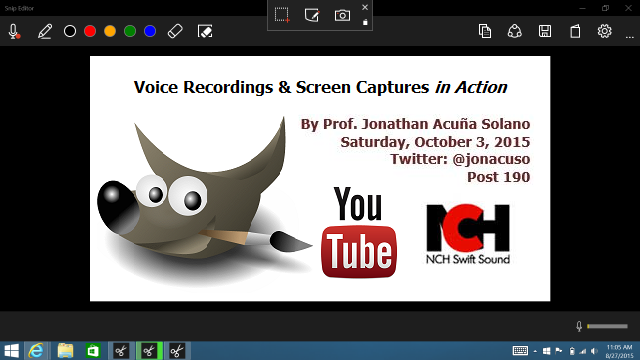
Voice Recordings & Screen Captures in Action

Reflective Teaching, Teaching Practices, Visual Literacy 0 comments


Voice Recordings & Screen Captures in Action

By Prof. Jonathan Acuña Solano
Saturday, September 3, 2015
Twitter: @jonacuso
Post 190

          The teaching of sounds of a different language is no easy task for learners nor for instructors. People develop different techniques to enroot segment proficiency, what I personally call the ability to produce sounds in the target language. Some students, whose ears are more “sensitive” to changes in sound quality can easily grasp differences in segments. On the other hand, there are other pupils whose strength is connected to visual learning, and the use of videos or flashcards is transcendental.

Being an English Language instructor at Universidad Latina in Costa Rica, mostly working with English Language Teaching students, I have come across with some difficulties in trying to teach them how to make a real difference when pronouncing certain vowels sounds such as the schwa [/ǝ/]. To have my students see the difference in articulation and jaw opening, I created the video that can be reproduced below entitled “Contrastive Words” (Acuña, 2015). To sum up, videos as part of “all forms of modeling-giving” (Underhill, 2005) are enriched ways to strongly introduce visual differences in sound articulation.

The creation of this video connected to the schwa production implied the use of different types of voice and screen capturing tools: a) Gimp for picture modification 2, b) Wave Pad to edit audio, c) Video Pad to stage one’s video, and d) mp3Gain to increase volume quality. The video is hosted in my personal Youtube Channel to be given the chance of an embedding code to have it in the university’s Moodle LMS and to be embedded in my pronunciation class blog.


My pronunciation class at the university is not an online class but a F2F one. To sort of moving into a hybrid learning atmosphere, I designed a pronunciation blog where I have included basically all that is covered in the 15-week course. This video is part of week 6, and it aims at visually presenting the student how the schwa differentiates from other English sounds and what position it takes within the vowel chart. The pronunciation student can either see this video at home directly from the class blog or on our Moodle LMS anytime it is needed. However, they are first introduced to it in class.

The main challenge in using voice recording along with screen captures is in terms of its simplicity. What Skye MacLeod –a former Language Fellow from the American Embassy in Costa Rica back in 2011- explained to me was that in order to create either a podcast or a vodcast, some steps need to be met:

1.    A format needs to be chosen to guarantee its briefness but also its focus;
2.    A script is required to guarantee the recording’s quality;
3.    The recording edition is vital to ensure good quality in sound and video; and
4.    The file format needs to be compatible with the hosting system so viewers will not experience any difficulty.

By following these simple steps we can mitigate challenges for the students or ulterior implications in use.
          “We’ve all heard the old adage ‘A picture is worth a thousand words.’ Learning to read those pictures gives us advantages in both work and life” (Toledo Art Museum, n.d.). Visual Literacy is now a term currently used in language learning to train students to observe and go beyond an initial response, but to go deeper into the analysis of what it is being observed, like the pronunciation of sounds within one’s mouth.

References


Acuña, J. (2015, February 22). Contrastive Words. [Video]. Retrieved from https://youtu.be/TUfX-9N8TaE

Toledo Art Museum. (n.d.). Visual Literay. Retrieved from Why Visual Literacy?: http://www.vislit.org/visual-literacy/

Underhill, A. (2005). Sound Foundations, Learning and Teaching Pronunciation (3rd Edtion ed.). Oxford: Macmillan Education.


Saturday, October 03, 2015


Newer Posts Older Posts Home
Subscribe to: Posts (Atom)

    Blog Stats

    Blog Stats
    Monday, August 10, 2026

    Reflective Online Teaching

    Reflective Online Teaching
    Since 2010

    Costa Rica

    Costa Rica
    My Home Country

    +550 Posts and counting

    +550 Posts and counting

    TESOL Certified Instructor

    TESOL Certified Instructor

    Certified Virtual Instructor

    Certified Virtual Instructor

    PD Talks & NCTE-Costa Rica

    PD Talks & NCTE-Costa Rica

    Copyscape

    Protected by Copyscape

    Blog Archive

    • ▼  2026 (72)
      • ▼  August (4)
        • Between Fate and Fear: A Psychological and Philoso...
        • Learning Begins with the Learner: Adapting ELT Res...
        • The Yellow Submarine to Pepperland: Art, Imaginati...
        • From Isolation to Collaboration: Adapting Communit...
      • ►  July (8)
      • ►  June (5)
      • ►  May (7)
      • ►  April (6)
      • ►  March (15)
      • ►  February (15)
      • ►  January (12)
    • ►  2025 (81)
      • ►  December (10)
      • ►  November (12)
      • ►  October (11)
      • ►  September (10)
      • ►  August (8)
      • ►  July (7)
      • ►  June (6)
      • ►  May (3)
      • ►  April (4)
      • ►  March (6)
      • ►  February (2)
      • ►  January (2)
    • ►  2024 (28)
      • ►  December (3)
      • ►  November (2)
      • ►  October (4)
      • ►  September (4)
      • ►  August (5)
      • ►  July (3)
      • ►  June (2)
      • ►  May (2)
      • ►  April (3)
    • ►  2023 (6)
      • ►  September (1)
      • ►  August (5)
    • ►  2022 (1)
      • ►  July (1)
    • ►  2020 (54)
      • ►  November (4)
      • ►  October (7)
      • ►  September (11)
      • ►  August (15)
      • ►  July (10)
      • ►  April (2)
      • ►  March (5)
    • ►  2019 (13)
      • ►  August (5)
      • ►  July (8)
    • ►  2018 (11)
      • ►  June (2)
      • ►  May (7)
      • ►  April (2)
    • ►  2017 (6)
      • ►  May (2)
      • ►  April (2)
      • ►  January (2)
    • ►  2016 (101)
      • ►  November (4)
      • ►  October (7)
      • ►  September (10)
      • ►  August (4)
      • ►  May (22)
      • ►  April (17)
      • ►  March (21)
      • ►  February (14)
      • ►  January (2)
    • ►  2015 (53)
      • ►  November (5)
      • ►  October (13)
      • ►  August (4)
      • ►  July (8)
      • ►  June (5)
      • ►  May (14)
      • ►  April (4)
    • ►  2014 (40)
      • ►  October (5)
      • ►  September (11)
      • ►  August (4)
      • ►  June (3)
      • ►  May (8)
      • ►  April (5)
      • ►  February (1)
      • ►  January (3)
    • ►  2013 (46)
      • ►  December (1)
      • ►  November (1)
      • ►  October (3)
      • ►  September (5)
      • ►  August (6)
      • ►  July (7)
      • ►  June (6)
      • ►  May (7)
      • ►  April (1)
      • ►  March (4)
      • ►  February (3)
      • ►  January (2)
    • ►  2012 (17)
      • ►  December (3)
      • ►  November (4)
      • ►  October (4)
      • ►  September (6)
    • ►  2011 (5)
      • ►  September (2)
      • ►  August (2)
      • ►  January (1)
    • ►  2010 (46)
      • ►  December (9)
      • ►  November (14)
      • ►  October (3)
      • ►  March (4)
      • ►  February (8)
      • ►  January (8)

    Labels

    • #EdChat (8)
    • #LTTO (14)
    • A Princess of Mars (1)
    • A Tale of Two Cities (1)
    • A Woman fo No Importance (1)
    • A1 Learners (1)
    • ABLA (9)
    • Academic Integrity (1)
    • Academic Research (9)
    • Adaptation (1)
    • Adaptive Expertise (1)
    • Adaptive Learning (1)
    • ADDIE Model (7)
    • Adult Education (3)
    • Adult ELT (1)
    • Adult Learners (3)
    • Adult Learning (3)
    • Adult Online Learning (1)
    • Adventure Fiction (2)
    • Aesthetics (1)
    • Affective Filter (3)
    • Afro-Caribbean Lore (1)
    • Agile Professional Development (1)
    • AI Detection (1)
    • AI Ethics (1)
    • AI in ELT (1)
    • Alberto Delgado Alvarez (1)
    • Aldous Huxley (1)
    • Aldus Huxley (1)
    • Alexander Luria (5)
    • Algorithmic Bias (2)
    • Alienation (2)
    • Ambiguity (1)
    • Analytical Thinking (1)
    • Anansi (1)
    • Ancient Astronaut Theory (1)
    • Ancient Civilizations (1)
    • Ancient Mysteries (1)
    • Andragogy (5)
    • Andy Curtis (1)
    • Angelology (2)
    • Animal Consciousness (1)
    • Animal-Machine (1)
    • António Vieira (1)
    • Aouda (1)
    • Apps for Education (1)
    • Archaeoastronomy (1)
    • Archaeology (1)
    • Archetypal Analysis (1)
    • Archetype (1)
    • Archetypes (1)
    • Archimedes (1)
    • Aristocracy (1)
    • Arsène Lupin (1)
    • Art and Technology (1)
    • Artificial Intelligence (4)
    • Artistic Philosophy in ELT (1)
    • Assessment (12)
    • Assessment in Action (2)
    • Assessment Literacy (1)
    • Assessment Practices (6)
    • ASSURE (1)
    • Asynchronous Tools (2)
    • Attention Span (1)
    • Augustine (1)
    • Aural/oral skills (1)
    • Authenticity (1)
    • Authoritarianism (1)
    • autonomous learning (1)
    • Autonomy (1)
    • Bamboo (1)
    • Baroque Thought (1)
    • Barsoom (1)
    • Barthesian Analysis (6)
    • Behavior (1)
    • Being vs. Having (1)
    • Benjamin Button (1)
    • Bergson (1)
    • Bernardo Soares (1)
    • Betrayal (2)
    • Bettelheim (1)
    • Biblical Monotheism (1)
    • Biblical Text Analysis (1)
    • Big Data (6)
    • Bilingualism (1)
    • Biopolitics (1)
    • Blended Learning (1)
    • BlendIt Course (8)
    • Blind Faith (1)
    • Blind Observations (1)
    • Bloom's Taxonomy (5)
    • Blue Meanies (1)
    • BNCs (9)
    • Board Work (2)
    • Book Critique (2)
    • Book of Enoch (1)
    • Book of Job (1)
    • Book of Revelation (1)
    • Bookmarking Sites (1)
    • Bourgeois Society (1)
    • Brave New World (1)
    • Brazilian Literature (4)
    • Brazilian Romanticism (2)
    • Breakout Rooms (3)
    • British Council (23)
    • Brotherhood (1)
    • Bureaucracy (3)
    • Burnout Prevention (1)
    • Cain (1)
    • Carl Jung (3)
    • Case Study (4)
    • Catalog of Rubrics (1)
    • Catastrophism (1)
    • Catholic Storytelling (1)
    • CEF (2)
    • CEFR (1)
    • CEFR-Aligned Assessment (1)
    • Centro Universitario de Desarrollo Intelectual (1)
    • Character Analysis (3)
    • Character Development (1)
    • Characterization (3)
    • Charles Dickens (1)
    • Christian Demonology (1)
    • Civil Obedience (1)
    • Civilization (1)
    • Classical Biography (1)
    • Classical Literature (1)
    • Classroom Interaction (2)
    • Classroom Management (8)
    • Classroom Organization (1)
    • Classroom Practice (1)
    • Classroom Routines (1)
    • Cloud Reader (1)
    • CLT (6)
    • Coaching (1)
    • Coaching in Teacher Classroom Observation (2)
    • Code of Ethics (1)
    • Cognition (1)
    • Cognitive Load (1)
    • Collaboration (1)
    • Collaborative Learning (1)
    • Collaborative Noticing (1)
    • Collectivism (1)
    • Colombian Poetry (1)
    • Color Motifs (1)
    • Communicating about Uncertainty (1)
    • Communicative Competence (4)
    • Communicative Language Teaching (7)
    • Communities of Practice (3)
    • Community of Practice (8)
    • Comparative Mythology (2)
    • Comparative Religion (2)
    • Comparative Studies (1)
    • Competency-Based Learning (9)
    • Conformity (2)
    • Conformity Pressure (1)
    • Connectivism (1)
    • Conscience (3)
    • Constructive Alignment (1)
    • Constructivism (1)
    • Contemporary Aesthetics (1)
    • Contemporary Short Fiction (1)
    • Content Assimilation (1)
    • Content Design (1)
    • Cooperative Learning (2)
    • CoP (3)
    • Corrective Feedback (4)
    • Cosmology (1)
    • Costa Rica (2)
    • Costa Rican Literature (1)
    • Course Project (2)
    • Coursebook Adaptation (1)
    • Creative Agility (1)
    • Creativity (2)
    • Critical reflection (1)
    • critical skills (1)
    • Critical Thinking (1)
    • Critical Thinking Skills (2)
    • Cultural Allegory (1)
    • Cultural Assimilation (1)
    • Cultural Centers (1)
    • Cultural Criticism (1)
    • Cultural responsiveness (1)
    • Culture (12)
    • Culture Framework (2)
    • Culture Teaching (8)
    • Curriculum Design (3)
    • Curriculum Development (7)
    • Custom eLearning (2)
    • Custom Training (1)
    • Dante Alighieri (2)
    • Dante Studies (2)
    • Darwinism (1)
    • Data Science (7)
    • Data-Driven Teaching (5)
    • Data-Informed Leadership (1)
    • David Fincher (1)
    • DDT (1)
    • Death (1)
    • Deborah Tannen (1)
    • Decadence (1)
    • Deductive Grammar Instruction (2)
    • Deep Ecology (1)
    • Dehumanization (1)
    • Demonology (2)
    • Demonology and Devil-Lore (2)
    • Demythologization (1)
    • Deontology (2)
    • Desire (3)
    • Destiny (1)
    • Determinism (1)
    • Developmental Feedback (1)
    • Dialogism (1)
    • Diane Larsen-Freeman (1)
    • Dictator (1)
    • Didactics (4)
    • Differentiation (4)
    • Digital Culture (1)
    • Digital Inequality (1)
    • Digital Pedagogy (2)
    • Digital Resources (1)
    • Dignity (1)
    • Dino Buzzati (1)
    • Discourse Analysis in ELT (1)
    • Distance Education (2)
    • Dreams (1)
    • Dualism (1)
    • Dysfunctional Families (1)
    • Dystopia (2)
    • Dystopian Fiction (1)
    • Dystopian Society (1)
    • E-Portfolios (1)
    • Eça de Queirós (11)
    • Eco-Criticism (1)
    • Edgar Rice Burroughs (3)
    • Education (1)
    • Education and Learning (34)
    • Education Policy (2)
    • Education Technologies (9)
    • Educational Evolution (1)
    • Educational Leadership (1)
    • Educational Philosophies (1)
    • EFL/ESL Activities (1)
    • El Clis de Sol (1)
    • eLearning (1)
    • Electracy (1)
    • ELF (1)
    • Elicitation (1)
    • ELL (17)
    • Elohim (3)
    • Elora Hary (1)
    • ELT (64)
    • ELT Conference (1)
    • ELT Institutions (1)
    • ELT Leadership (1)
    • ELT Methodology (1)
    • ELT Pedagogy (2)
    • ELT Professional Development (3)
    • ELT. Teacher Growth (1)
    • Emotional Intelligence (1)
    • Emotional Literacy (2)
    • Emotional Repression (1)
    • Empathy (1)
    • English Grammar (3)
    • English Language Teaching (15)
    • English Teaching (1)
    • Enkidu (1)
    • Environmental Destruction (1)
    • Environmental Philosophy (1)
    • Envy (1)
    • Epistemology (1)
    • Equity (1)
    • Eric Mazur (1)
    • Erich Fromm (4)
    • Error Correction (2)
    • Escape from Freedom (1)
    • Eschatology (1)
    • Esotericism (1)
    • ESP (2)
    • Ethical Inaction (1)
    • Ethical Judgment (1)
    • Ethical Judgments (1)
    • Ethical Leadership (1)
    • Ethical Sacrifice (1)
    • Ethics (47)
    • Ethics Analysis (2)
    • Ethics Education (1)
    • Ethics of Care (1)
    • Etiological Storytelling (1)
    • Evaluating Digital Tools (1)
    • Evaluation (4)
    • Evil (1)
    • Evolution (1)
    • Executives' School (9)
    • Existentialism (1)
    • Ezekiel (1)
    • F. Scott Fitzgerald (1)
    • Fairy Tales (2)
    • Faivre (1)
    • False Positives (1)
    • Fantastic (2)
    • Fatalism (2)
    • Fear (1)
    • Feedback (5)
    • Female Identity (1)
    • Fernando Pessoa (1)
    • Flipped Classroom (1)
    • Flipped Learning (1)
    • Focus on Form (1)
    • Folklore (1)
    • Formative Assessment (5)
    • Forums (1)
    • Fossilization (1)
    • Frames-Based Teaching (1)
    • Framing in Discourse (1)
    • Frankenstein (1)
    • Franz Kafka (1)
    • Free Will (1)
    • Freedom (1)
    • French Literature (2)
    • Freudian Analysis (3)
    • From theory to practice (2)
    • Frommian Analysis (2)
    • Fulfillment (1)
    • Future for Education? (2)
    • Gabriel Escorcia Gravini (1)
    • Gamification (1)
    • Genesis (1)
    • George Orwell (1)
    • George Sand (1)
    • Global Competence (1)
    • Global Ethics (7)
    • Gnosticism (1)
    • Gothic Literature (1)
    • Gothicism (1)
    • Grading Ranges (1)
    • Graham Hancock (1)
    • Grammar (3)
    • Greed (1)
    • Group Dynamics (2)
    • Group Work (2)
    • Guest Author (1)
    • Guided Practice (2)
    • Guilt (1)
    • H. G. Wells (1)
    • H.P. Lovecraft (3)
    • Haiku (2)
    • Hanegraaff (1)
    • HD Brown (1)
    • Hebrew Mythology (1)
    • Hermeticism (2)
    • Hero's Journey (1)
    • Hero’s Journey (1)
    • Hesitation (1)
    • Higher Education (49)
    • Higher Education Ethics (1)
    • Historical Context (1)
    • Historical–Biographical Criticism (1)
    • History (2)
    • Holistic Education (1)
    • Homer (1)
    • Homerton College Cambridge Course (2)
    • Hootcourse (1)
    • Horacio Quiroga (1)
    • Human Dignity (1)
    • Human Rights (1)
    • Human-Centered Narrative (1)
    • Human-Centered Pedagogy (1)
    • Humanistic Morality (1)
    • Humanity (1)
    • Hybrid and Blended Learning (61)
    • Hybrid In-person Teaching (1)
    • Hybrid Learning Models (1)
    • Ice Age (1)
    • Identit (1)
    • Identity (2)
    • Ideology (3)
    • Idioms (1)
    • Iktomi (1)
    • Imagery (2)
    • Imagination (1)
    • Inclusive Education (1)
    • Inclusive Pedagogy (2)
    • Independent Practice (1)
    • Indianism (1)
    • Indigenous Heroism (1)
    • Individuation (3)
    • Inductive Grammar Instruction (2)
    • Inferno XXXIII (1)
    • infographic (1)
    • Institutional Culture (1)
    • Institutional Improvement (1)
    • Institutional Memory (1)
    • Instruction-Giving (1)
    • Instructional Design (4)
    • Integration of Technology into Teaching (10)
    • Interaction (1)
    • Interaction Patterns (2)
    • Intercultural Awareness (1)
    • Interdisciplinary Inquiry (1)
    • Interlanguage (2)
    • Intertextuality (1)
    • Interventions in ELL (1)
    • Irony (4)
    • Isaac Asimov (1)
    • Issus (1)
    • Italian Literature (1)
    • Jacqueline Alves Souza (1)
    • Jacques de Molay (1)
    • Jacques Lacan (4)
    • James Knowles (1)
    • James Thurber (1)
    • Japanese Folklore (1)
    • Jehovah (1)
    • Jeremiah (1)
    • Jewish Apocalypticism (1)
    • Jewish Mysticism (1)
    • John Carter (3)
    • José de Alencar (2)
    • JotForm (1)
    • Journey (1)
    • Journey to the Center of the Earth (1)
    • Jules Verne (3)
    • Jungian Analysis (9)
    • Just-in-Time Training (1)
    • Kabbalah (1)
    • Kahlil Gibran (2)
    • Kathleen M. Bailey (1)
    • Kazinczy (1)
    • Kindness (1)
    • King Arthur and his knights (1)
    • Kirkpatrick Model (15)
    • Knight Templars (1)
    • Knowledge (1)
    • Kurt Vonnegut (1)
    • La Buenaventura (1)
    • La gran miseria humana (1)
    • La Insolación (1)
    • Lacan (1)
    • Lacanian Analysis (7)
    • Lacanian Psychoanalysis (1)
    • Language (1)
    • Language Competences (1)
    • Language Education (2)
    • Language Institutions (1)
    • Language Learning (15)
    • Language Series Comparative Analysis (1)
    • Language Teaching (9)
    • Latin American Literature (3)
    • Laureate Course Module 3 Teaching with Technology (19)
    • Laureate Educator (4)
    • Laureate Educator in the XXI Century (2)
    • Laureate Educator-Week 1 (1)
    • Laureate Educator-Week 2 (1)
    • Laureate Educator-Week 3 (1)
    • Le Drac (1)
    • Leadership (10)
    • Learner Agency (1)
    • Learner Anxiety (1)
    • Learner Attention (1)
    • learner autonomy (5)
    • Learner Confidence (1)
    • Learner Diversity (3)
    • Learner Engagement (1)
    • Learner Experience (1)
    • Learner Grouping (2)
    • Learner Uptake (1)
    • Learner-Centered Instruction (2)
    • Learner-Centered Pedagogy (1)
    • Learner-Centered Teaching (1)
    • Learner-Centeredness (1)
    • Learning (8)
    • Learning Activities (1)
    • Learning Analytics (1)
    • Learning Objectives (2)
    • Learning Preferences (1)
    • Learning Styles (1)
    • Learning Technologies (1)
    • Leopoldo Lugones (1)
    • Les Demoiselles d’Avignon. Pablo Picasso (1)
    • Lesson Closure (1)
    • Lesson Design (2)
    • Lesson Openings (1)
    • Lesson Planning (6)
    • Lev Vygotsky (4)
    • Libraries (1)
    • Life is a Dream (1)
    • Life Stories (1)
    • Linguistics (2)
    • Listening (1)
    • Literary Analysis (8)
    • Literary Characterization (1)
    • Literary Criticism (28)
    • Literary Ethics (1)
    • Literary Psychology (1)
    • Literature (36)
    • Livro do Desassossego (1)
    • LMS (6)
    • Lord’s Prayer (1)
    • Lost Civilization (1)
    • LOTI Profile (5)
    • Love (2)
    • Lycurgus (1)
    • Machado de Assis (2)
    • Machiavellian Narration (1)
    • Mãe (1)
    • Magón (1)
    • MakerSpace (1)
    • Manuel González Zeledón (1)
    • Marcel Duchamp (6)
    • Marcellus (1)
    • Marxist Literary Approach (1)
    • Mary Shelly (1)
    • Materials Design (1)
    • Materials Development (3)
    • Maurice Leblanc (1)
    • Meaning of Justice (1)
    • Megalithic Architecture (1)
    • Melodrama (1)
    • Mentalism (1)
    • Mentorship (1)
    • MEP (Ministerio de Educación Pública) (1)
    • Metacognition (3)
    • Metadata (1)
    • Metalinguistic Feedback (1)
    • Metaphor (1)
    • Metaphysics. Self-Mastery (1)
    • Methodology (3)
    • Micro-Ethics (1)
    • microcelebrities (1)
    • Microlearning (1)
    • Mimetic Desire (1)
    • Mind Maps (2)
    • Mindfulness (12)
    • Misogyny (1)
    • Mistake vs. Error (1)
    • Mixed-Ability Classes (1)
    • Mixed-Methods Research (4)
    • Mobile Learning (1)
    • Modeling in ELT (1)
    • Modern Realism (1)
    • Modernity (3)
    • Modular Learning (1)
    • Moncure Daniel Conway (5)
    • MOOCs (1)
    • Moodle (5)
    • Moral Agency (1)
    • Moral Allegory (1)
    • Moral Biography (1)
    • Moral Cannibalism (1)
    • Moral Education (1)
    • Moral Failure (1)
    • Moral Lesson (1)
    • Moral Philosophy (2)
    • Moral Responsibility (2)
    • Moral Theology (2)
    • Moral-Humanistic Criticism (1)
    • Morality (2)
    • Motherhood (1)
    • Motivation (3)
    • Multimedia Learning (1)
    • Music (1)
    • Music and Learning (1)
    • Myth (1)
    • Myth Interpretation (1)
    • Myth of Evil (1)
    • Mythic Narrative (1)
    • Mythological Archetypes (1)
    • Mythology (3)
    • Narrative (1)
    • Narrative Distance (1)
    • Narrative Empathy (1)
    • Narrative Identity (1)
    • Narrative Irony (1)
    • Narrative pedagogy (1)
    • Narrative Structure (5)
    • Narrative Voice (1)
    • Nature (1)
    • Nature Spirits (1)
    • Necropolitics (1)
    • Needs Assessment (3)
    • Netiquette (1)
    • Network Community (1)
    • NGL (1)
    • Nicaraguan Literature (2)
    • Nicatesol (1)
    • Nietzsche (1)
    • Nive Events of Instruction (1)
    • Nonviolent Communication (6)
    • ñor Cornelio Cacheda (1)
    • Noticing (1)
    • Noticing Hypothesis (2)
    • Nouns in English (1)
    • Novice Teachers (3)
    • Nudos (1)
    • O Mandarim (2)
    • Objective Writing (1)
    • Odysseus (1)
    • OER (1)
    • Off-the-Shelf Learning (1)
    • Online Community (1)
    • Online EFL (1)
    • Online English Language Teaching (1)
    • Online Instruction (55)
    • Online Language Teaching (2)
    • online learning (50)
    • Online Learning Programs (1)
    • Online Persona (9)
    • Online Program Design (1)
    • online teaching (9)
    • Online Teaching Approach (1)
    • Online Teaching Practices (72)
    • Oral Assessment (1)
    • Oral Communication (1)
    • Oral Skills (2)
    • Organizational Learning (1)
    • Orientalism (1)
    • Origins (1)
    • Oscar Wilde (1)
    • Output Hypothesis (1)
    • Padre Luis Coloma (1)
    • Paideia (1)
    • Paper.li (1)
    • Pasolini (2)
    • Passepartout (1)
    • Pater Noster (1)
    • Paul of Tarsus (1)
    • Paz a los muertos! (1)
    • PBL (1)
    • PD (2)
    • Peace to the Dead! (1)
    • Pedagogy (2)
    • Pedro Antonio de Alarcón (1)
    • Pedro Calderón de la Barca (1)
    • Peer Correction (1)
    • Peer Instruction (1)
    • Penitence (1)
    • Penny Ur (2)
    • Pepperland (1)
    • Persona (2)
    • Personal Learning Networks (2)
    • Personalization (1)
    • Pessimism (1)
    • Phileas Fogg (1)
    • Philip K. Dick (1)
    • Philosophy (1)
    • Phonemics (4)
    • Phonetics (4)
    • Phonotactics (3)
    • Pilot Programs (1)
    • PLEs and PLNs for Lifelong Learning Competencies Week 1 (1)
    • Plot Analysis (2)
    • Plutarch (6)
    • Poetry (2)
    • Poetry Analysis (1)
    • Political Discourse (1)
    • Political Heroism (1)
    • Political Terminology (1)
    • Popol Vuh (1)
    • Population Control (1)
    • Portuguese Literature (3)
    • Portuguese Realism (1)
    • Postcolonialism (1)
    • Posthumanism (1)
    • Prehistory (1)
    • Pride (1)
    • Procrustean Syndrome (1)
    • Produsage (1)
    • Produser (1)
    • Professional Capital (2)
    • Professional Competencies (1)
    • Professional Development (11)
    • Professional Growth (1)
    • Professional Identity (2)
    • Projec-Based Learning (1)
    • Promethean Myth (1)
    • Pronunciation (7)
    • Psychoanalysis (2)
    • Psychological Analysis (2)
    • Psychological Punishment (1)
    • Psychological Resilience (1)
    • Psychological Transformation (1)
    • Psychology (1)
    • Public Speaking (1)
    • Purgatorio XI (1)
    • Qualitative Research (4)
    • Quantitative Research (4)
    • Quest (1)
    • Rapport (2)
    • rationality (1)
    • Reading (1)
    • Reading and Vocabulary (2)
    • Realism (3)
    • Recasts (1)
    • Reception Theory (1)
    • Recruitment (1)
    • Recycling in Education (1)
    • Reflective Communities (1)
    • Reflective Evaluation (2)
    • Reflective Journaling (5)
    • Reflective Practice (23)
    • Reflective Reading (1)
    • Reflective Teacher Communities (1)
    • Reflective Teacher Leadership (1)
    • Reflective Teaching (60)
    • Religion (1)
    • Religious Authority (1)
    • Religious Critique (1)
    • Religious Evolution (1)
    • Research (9)
    • Resilience (3)
    • Resource Adaptation (2)
    • Responsibility (1)
    • Return on Investment (1)
    • Richard Schmidt (2)
    • Risk Communication (1)
    • Robert Frost (1)
    • Robert Gagné (2)
    • ROI (1)
    • ROI in ELT (1)
    • Roland Barthes (3)
    • Roman Conquest (1)
    • Roman Offices (1)
    • Roman Republic (1)
    • RTC (1)
    • Ruben Puentedura (1)
    • Rubric-Based Planning (1)
    • Rubrics (3)
    • Samael (1)
    • SAMR Model (1)
    • Sanctity (1)
    • Scaffolding (3)
    • Schema (1)
    • Scholasticism (1)
    • Science Fantasy (1)
    • Science Fiction (2)
    • Science Fiction Studies (1)
    • Scoop.it! (1)
    • Second Language Acquisition (5)
    • Secret Societies of the Middle Ages (1)
    • Self-Fulfilling Prophecy (1)
    • Semantic Change (1)
    • Semiotics (2)
    • Sentence Patterns (1)
    • Sermão de Santa Teresa (1)
    • Shadow (3)
    • Short Films (1)
    • Short Stories (4)
    • Short Story Analysis (1)
    • Simplicity (1)
    • Sioux Legends (3)
    • Sir Gareth (1)
    • Sir Gawain (1)
    • Sir Lancelot (1)
    • Sir Tristam (1)
    • Skepticism (1)
    • Sketchpads (1)
    • Skill Gap Analysis (1)
    • SLA (4)
    • Slavery in Brazil (1)
    • Social Agency (1)
    • Social Criticism (1)
    • Social Critique (2)
    • Social Language (3)
    • Social Media (29)
    • Social Networking in Education (3)
    • Social Perception (1)
    • Social Satire (1)
    • Social Transformation (1)
    • Sociocultural Theory (1)
    • Son of Man (1)
    • Spanish Literature (1)
    • Sparta (1)
    • Speaking (1)
    • Speaking Scenarios (1)
    • Stephen Krashen (1)
    • Sticky Curriculum (1)
    • Storytelling (1)
    • Strategies for online teaching (2)
    • Student Agency (1)
    • Student Assessment (1)
    • Student Engagement (2)
    • Student Interest (3)
    • Student Motivation (2)
    • Student Talk Time (1)
    • Student Tips (2)
    • Subjectivity (1)
    • Sumerian (1)
    • Summative Assessment (2)
    • Supernatural (1)
    • Supernaturalism (1)
    • Supervision (1)
    • Supplementary Materials (1)
    • Sustainability (2)
    • Symbolic Philosophy (1)
    • Symbolism (6)
    • Synchronous Online Teaching (1)
    • Syntax (2)
    • Syracuse (1)
    • Task-Based Instruction (1)
    • Task-Based Language Teaching (1)
    • Task-Based Learning (1)
    • TBI (1)
    • TBLT (3)
    • Teacher Agency (3)
    • Teacher Cognition (1)
    • Teacher Correction (1)
    • Teacher Development (25)
    • Teacher Education (1)
    • Teacher Evaluation (2)
    • Teacher Feedback (2)
    • Teacher Identity (2)
    • Teacher Inquiry (1)
    • Teacher Mentoring (2)
    • Teacher Mentorship (1)
    • Teacher Observation (1)
    • Teacher Professional Development (2)
    • Teacher Reflection (2)
    • Teacher Training (5)
    • Teacher Well-being (4)
    • Teacher Well-Being. Kirkpatrick Model (1)
    • Teacher–Student Relationships (1)
    • Teaching (47)
    • Teaching Adolescents (1)
    • Teaching Aids (1)
    • Teaching ePortfolio (1)
    • Teaching Grammar (2)
    • Teaching Models (1)
    • Teaching Online (9)
    • Teaching Philosophy (4)
    • Teaching Portfolio (1)
    • Teaching Practices (49)
    • Teaching Practicum (22)
    • Teaching Presence (2)
    • Teaching Styles (8)
    • Teaching Tips (9)
    • Teaching With Technology (4)
    • Teaching With Technology-Week 1 (1)
    • Teaching With Technology-Week 2 (1)
    • Teaching With Technology-Week 3 (2)
    • Teaching With Technology-Week 4 (4)
    • Teaching With Technology-Week 5 (3)
    • Teaching With Technology-Week 6 (2)
    • Teaching With Technology-Week 7 (3)
    • Teaching With Technology-Week 8 (2)
    • Teaching With Technology-Week 9 (1)
    • Tech Tip (5)
    • Technocriticism (1)
    • Technological Assessment (2)
    • Technology Use Tips (1)
    • TED (1)
    • Templars (1)
    • Temporal Paradox (1)
    • Temporality (1)
    • Temptation (2)
    • Teodoro (1)
    • Testing (1)
    • The Art of Loving (1)
    • The Assassins (1)
    • The Beatles (1)
    • The Book of Proverbs (1)
    • The Butterfly Circus (1)
    • The Cats of Ulthar (1)
    • The Data Scientist (5)
    • The Epic of Gilgamish (1)
    • The Gods of Mars (1)
    • The Kybalion (2)
    • The Loincloth (1)
    • The New Normal (1)
    • The Noticing Hypothesis (2)
    • The Outsider (1)
    • The Prophet (2)
    • The Real (1)
    • The Road Not Take (1)
    • The Skull (1)
    • The Time Machine (1)
    • Theater Criticism (1)
    • Themistocles (1)
    • Theophoric Names (1)
    • Theseus (1)
    • Thomas Keightley (2)
    • Thomistic Ethics (2)
    • Thomistic Grace (1)
    • Timing of Correction (1)
    • Todorov (1)
    • Tolkien (1)
    • Transformation (1)
    • Trickster (1)
    • Trinity (1)
    • Turnitin (1)
    • Tzvetan Todorov (1)
    • UCC (1)
    • Ugarit (1)
    • Ugolino (1)
    • Universidad Mariano Gálvez (2)
    • Unreliable Narration (1)
    • Unreliable Narrator (1)
    • Utilitarianism (2)
    • Utopia (1)
    • Vengeance (1)
    • Videoconferencing Platforms (1)
    • Virtual Classroom Features (1)
    • Virtual Classroom Management (1)
    • Virtual Classrooms (1)
    • Virtual Learning Environments (8)
    • Virtual Teaching (5)
    • Virtualized Teaching (1)
    • Virtue (1)
    • Visual Literacy (1)
    • Visual Scaffolding (1)
    • VLE (47)
    • VLEs (38)
    • Vocabulary learning (10)
    • WAS (14)
    • Wealth (1)
    • Web 2.0 (4)
    • Web search engine options (1)
    • Web Tools (6)
    • WebQuests (1)
    • Western Esotericism (1)
    • Western Mysticism (1)
    • Wilbert Salgado (12)
    • William Elliot Griffis (1)
    • Willingness to Communicate (1)
    • Working Adult Student (5)
    • Workplace Dynamics (1)
    • writing (2)
    • Writing Skills (1)
    • Yahweh (1)
    • Yzur (1)
    • Zecharia Sitchin (1)
    • Zone of Proximal Development (1)
    • ZPD (1)

Copyright © All Rights Reserved. Reflective Online Teaching | Converted into Blogger Templates by Theme Craft