skip to main | skip to sidebar
Reflective Online Teaching
My Personal Site for Reflective Teaching
RSS
    Jonathan Acuña Solano, Post Author
    Contact Email: jonacuso@gmail.com

Showing posts with label Teaching Styles. Show all posts

Is it So Difficult to Increase the TL in Classroom Interactions?

Teacher Development, Teaching, Teaching Practices, Teaching Styles 0 comments


Is it So Difficult to Increase the TL in Classroom Interactions?

By Prof. Jonathan Acuña Solano
Tuesday, July 7, 2015
Twitter: @jonacuso
Post 180

“With the rise of Communicative Language Teaching (CLT) and a growing emphasis on oral communication skills, the role of student talk in the language classroom has become more important than ever” (Hilliard, 2014). This can be seen across the globe in ELT settings where language instructors are reluctant to use the target language (TL) as the means of instruction in the classroom, and Costa Rica is not the exception from this futile teacher practice. Knop (n.d.), in an article published by Emory University, stresses the importance the TL has in the cognitive development of students who are learning a foreign language. “Excessive TTT [Teacher Talking Time] limits the amount of STT (student talking time). If the teacher talks for half the time in a 60 minute lesson with 15 students, each student gets only 2 minutes to speak” (Darn, 2007). Then, the rhetorical question stays in the air; is it so difficult to increase the TL in classroom interactions?

Knop (n.d.) proposes a series of steps to increase the use of TL use in the classroom; what are her language practice proposals? Knop’s proposal –though not necessarily connected to the English Teaching per se- focuses its attention on the promotion of student interaction in class along with having learners use the TL; Knop’s ideas are: a) language ladders, b) day’s lesson plan on board, c) informal pair & S2S interactions, d) Gouin series, e) amount of “teacher talk,” f) authentic and appropriate input, and g) class participation in the TL. For Knop (n.d.), these classroom practices can encrease the amount of student talk, but this will not “happen overnight;” these “strategies need to be tried out and implemented in a progressive manner over a period of time” (Knop, n.d.) to really witness some language use change in classroom settings.

Hilliard (2014), similarly to Knop (n.d.), puts it simply, language teachers have to “start each class with a speaking activity,” something that is quite close to what Knop labels as language ladders. A language ladder is a “set of commonly used classroom expressions focused on classroom function.” And as Hilliard’s (2014) proposal regarding a speaking activity, Knop (n.d.) suggests using a great array of speaking activities that can set the mood for the class to start speaking, on the one hand by St2T interactions (i.e. seeking information, expressing confusion, making excuses, asking persmission, making small talk, exchanging greetings and leave-takings, giving directions, praising and encouraging, and disciplining), and on the other hand, St2St interactions (expressing likes & dislikes, expressing agreement and disagreement, giving compliments, inviting someone, and accepting and refusing and invitation). All of these suggested language ladders can be labeled as possible ways to test learner’s descriptors in the ACTFL guidelines (American Council on the Teaching of Foreign Languages, 2012) or even traced within the can-do table proposed by ETS for the TOEIC test (Educational Testing Services, 2000).

Not only Knop (n.d.) but also Hilliard (2014) have similar suggestions regarding TL use in the classroom. Hilliard (2014) proposes to “let students do the work for you.” In this line of thought, it is possible to group Knop’s nomenclatures for the steps to follow for teacher’s lesson plans and her taxonomy for “informal pair” interactions (Knop, n.d.). Instead of fostering excessive teacher talk, Knops wants to have language students make use of the language during class interactions. “Another way of helping students understand and use the target language is to put an outline of the lesson plan” on the board, says Knop (n.d.). For this very reason, Knop adduces that it is necessary to use the lesson plan on the board at the start of class, during class, and at the end of class (n.d.). The use of the outline of the instructor’s plan can help language students to review material before major tests and quizzes; it can give language trainees a sense of transition from topic to topic and of closure towards the end of the lesson; and it can provide students with a sense of accomplishment.

“TTT often means that the teacher is giving the students information that they could be finding out for themselves, such as grammar rules, the meanings of vocabulary items and corrections” (Darn, 2007). Bearing in mind Hilliard’s (2014) idea of having learners do the instructor’s work is to follow Knop’s (n.d.) suggestions for “informal pairs” interactions. Knop (n.d.) pigeonholes ten different types of language activities in her taxonomy aiming at having students do the talking themselves: a) warm-ups, b) study of new verbs, c) learning of a dialogue, d) vocabulary study, e) grammar work, f) dictations, g) naming, h) expressing references, i) describing and j) sharing information. All these kinds of activities are great paths to guide learners towards the use of the TL language in the classroom rather than just listening to the teacher talk. As suggested by Darn (2007), “a large amount of TTT results in long stretches of time in teacher-to-class (T/class) mode and a monotonous pace. Student under-involvement inevitably leads to loss of concentration and reduced learning.” Knop’s (n.d.) thesis combined with Hilliard’s (2014) proposal can indeed produce another kind of class interaction in which student talk prevails.

Though the term Gouin Series Method is not a new term in language learning, it derives its name from its inventor, François Gouin, a French Latin teacher. The approach advocated by Gouin is “to have ‘themes’ such as The Plant and to have students memorize sentences in sequence relating to the theme” (Martin, 2009). For Knop (n.d.), Gouin Series are “organized in a logical sequence and students are usually directed to say the sentences while acting them out.” As pointed out by the author herself, Gouin Series do use “several meaning reinforcers” (Knop, n.d.), allowing students to review language and use it fully attached to meaning and use. Gouin Series will “appeal to various senses” and will “help teach appropriate behavior in a cultural activity” (Knop, n.d.). At a cognitive level, language students are motivated to be using the “three-dimensional grammar framework” endorsed by Larsen-Freeman (n.d.), where students not only exercise how a stucture is constructed, but how it is used properly within a social context and what it means for the native speakers when such a structure is built and used to convey meaning. By means of the “three-dimensional grammar framework,” which must be borne in mind by language instructors at all times, students can discover cultural information about the language, which is only encased in exercises where a critical, mental chronology of events can be sequenced. And aside from the cultural component attributed to Gouin Series, language instructors can also “engage students in active practice of the sentences and actions” (Knop, n.d.), connected in form, meaning, and use.

Hilliard (2014) recommends implementing “more authentic, communicative classroom activities.” However, though Gouin Series are a good first attempt to provoke communication in the classroom, they do not necessarily yield the expected outcome at all times. “Anything from pair work and group work, to discussions and debates, to task-based activities and games can be utilized within a CLT framework” (Hilliard, 2014). But all these intances mentioned here must be nurtured by the provision of authentic “input” in classroom interaction (Knop, n.d.). “Considering to the concept of authentic language input, Gilmore (2007) defined authentic language input as the language carrying a real message which is created by a real speaker or writer for a real audience” (Bahrani & Soltani, 2012). So how can authentic input be provided to students so they can get to use the language in class?

“Bearing in mind the nature of the communicative classroom, teachers should perhaps be aware of the quality of their TTT and how it is used rather than trying to reduce it to a bare minimum” (Darn, 2007). But still, are we providing input that is varied, authentic, and appropriate? If we are not meeting the standards set by Bahrani & Soltani (2012), we are bound to be providing inauthentic input, bound to be directing classroom activities inappropriately, or bound to exert some more control over the input that we are giving (Knop, n.d.). Authentic input/material can be imported into the classroom from various sources, and it can help studends develop the target language if used properly; otherwise, we will be responsible for its failure.

Knop’s (n.d.) unique most significant addition to the use of the TL in the classroom is not linked to authenticity in the input, but the surpassing importance of keeping track of students’ participation. “A record participation is important since in-class performance is considered an integral part of a student’s grade” (Knop, n.d.). By doing so, the instructor can know –even as backwash- where his/her attention is focused when practicing the TL in the classroom. “An ‘oral participation grade’ might be given out to students, based on the summary of point or grades earned for the frequency of their contributions and their use of the TL” (Knop, n.d.). This can be indeed used as a way to make language trainees aware of their active role or chosen passivity in the classroom. In other words, learners have to be aware of the implications of activity or inactivity in class and how it may affect their performance grade and, why not, language development, learning, and acquisition.

As neatly stated by Knop (n.d.), the increase TL use in class will not happen overnight. “Strategies need to be tried out and implemented in a progressive manner over a period of time” (Knop, n.d.). Pesce (n.d.) subscribes “to the theory that in the case of beginners, the ratio of TTT vs. STT should be 50-50, and this percentage should progressively change till you achieve a 30% TTT vs. 70% STT.” But Pesce (n.d.) points out, as suggested by Knop (n.d.), that the teacher needs to identify what really works for his/her class, but class attention, talk, and participation must be fixed upon the learner. Once these three elements are fixed on the student, the strategies proposed here can help educators increase the use of the target language in all classroom interactions.


American Council on the Teaching of Foreign Languages. (2012). ACTFL Proficiency Guidelines 2012. Alexandria, VA, USA: ACTFL.ORG.

Bahrani, T., & Soltani, R. (2012, February 2). An Overview on How to Utilize Authentic Language Input for Language Teaching. (P. M. S. Thirumalai, Ed.) LANGUAGE IN INDIA, 12, 800-807. Retrieved June 20, 2015

Darn, S. (2007, August 15). Teaching English. Retrieved June 20, 2015, from BBC British Broadcasting Corporation: http://www.teachingenglish.org.uk/article/teacher-talking-time

Educational Testing Services. (2000). TOEIC Can-Do Guide. New Jersey, New Jersey, USA: The Chauncey Group.

Hilliard, A. (2014, February). TESOL Connections. Retrieved June 20, 2015, from TESOL Connections: http://newsmanager.commpartners.com/tesolc/issues/2014-02-01/3.html

Knop, C. (n.d.). Language Center. Retrieved June 17, 2015, from Emory College of Arts and Science: http://languagecenter.emory.edu/home/documents/constanceknop.pdf

Larsen-Freeman, D. (n.d.). Institut für Anglistik. Retrieved June 20, 2015, from Universität Innsbruck: http://www.uibk.ac.at/anglistik/staff/freeman/course-documents/tesfl_-_teaching_grammar.pdf

Martin, J. (2009, February 18). The Language Nest. Retrieved June 20, 2015, from The Language Nest: http://languagenest.blogspot.com/2009/02/designing-gouin-series.html

Pesce, C. (n.d.). Busy Teacher. Retrieved June 20, 2015, from Busy Teacher: http://busyteacher.org/13959-how-to-increase-student-talking-time-7-techniques.html


Is It So Difficult to Increase the TL in Classroom Interactions? by Jonathan Acuña


Tuesday, July 07, 2015


Minding Your Own Language Learning

Mindfulness, Reflective Teaching, Teaching Practices, Teaching Styles 0 comments


Minding Your Own Language Learning

By Prof. Jonathan Acuña Solano
Sunday, June 28, 2015
Twitter: @jonacuso
Post 177

          Mindfulness does not just mean to be aware of what others do or feel (or what I, as an individual feel and do), but it is a conscious act that allows us to introspectively and retrospectively analyze how things happen(ed) in life, such as the way a foreign language was acquired. At times it is helpful to place oneself in the shoes of one’s learners to tell them that one understands what they are going or have gone through as language students. Let’s mindfully ask ourselves these questions or just read the following answers.

          “What were the contexts in which you felt you were most successful in learning a language?” Since now I am getting to understand language learning processes better, in hindsight I can see myself years ago learning English and being exposed to lots of social interaction in class, but with one professor I got at University of Costa Rica whose class was solely delivered from her desk. Prof. Pacheco never gave me or my partners any way to socially work with other peers to try out the development of our interlanguage and test our comprehension of the target language. Now as an ELT instructor, and thanks to that Prof. Pacheco, in a mindful act for the sake of my lesson plan, I provide my pupils with zone-of-proximal-development opportunities to exercise their English, to feel comfortable in my class, and to give their interlanguage a try. Somehow I want to guarantee that my language trainees get a classroom setting that inspires them with activities that can foster their language proficiency in a social context.

          “Did you learn best in a classroom context?” With language instructors such as Prof. Pacheco at UCR, I cannot see much evolution of language in learners (because I saw none in my case). But my personal language learning story is not just connected to a single unmindful teaching professional; there were people who really helped me a lot to continue developing my language. However, being retrospectively and mindfully alert, the classroom context was not the best place for me oftentimes. There were partners who recurrently went back to our native language to discuss what the instructor asked us to consider and talk over among ourselves. Committed peers were not always nearby, and for that reason I self-taught myself many things I could not either learn with my uncooperative peers or in a class that turned out to be too theoretical and abstract for me or socially tracked off. As a language instructor, and in an act of mindfulness once more, my students are much more involved in routine tasks that can assist them to help them develop their language proficiency in various ways: from grammar to pronunciation, and from social skills to hierarchical thinking skills. Anything that resembles the way native speakers use the language in a foreign country is something that can be tried out in class to help learners construct their knowledge of the target language and to practice it.

          “If you have visited a country where you had to learn at least some basics of a second language, what helped? What didn’t help?” As a language learner, I never visited any English-speaking country, nor did I have to learn the basis of a second language in a foreign country. I learned English in my Spanish-speaking home country. It was until later in life, as a graduate student, when I had the opportunity to travel to the United States for a teacher training course, several years after I had graduated from UCR. But before that traveling chance materialized, there were plenty of British, American, and Canadian native speakers who shared their language with me through lengthy conversations or small chats. In a mindful act in the search to improve my language proficiency, I looked for any opportunity to have a conversation with a native speaker to –once again- try out the evolution of my interlanguage. At this point of my professional teaching life, I recurrently ask my pupils to go and look for those opportunities to practice their English! And better yet, if they can travel to an English-speaking country for a while, I ask them to seize the chance and explore other linguistic horizons that are only hosted in a country where the target language is spoken.


          In brief, as a language instructor one has to be mindful of how one’s language learning process took place. Our experiences can be guiding stars for what we want to instill in our learners to experience a more down-to-earth and meaningful way of learning or to go and search for language experiences that can help them learn, consolidate their learning, or try out what has been learned and moved into the interlanguage. We were foreign language learners; why can’t we use all that experience to assist our students in their language learning journey?


Minding Your Own Language Learning by Jonathan Acuña


Sunday, June 28, 2015


Redesigning One’s Lessons: The Importance of Reflective Teaching

Lesson Planning, Reflective Teaching, Teaching, Teaching Practices, Teaching Styles, Teaching Tips 0 comments


Redesigning One’s Lessons:
The Importance of Reflective Teaching

By Prof. Jonathan Acuña Solano
Friday, October 3, 2014
Twitter: @jonacuso
Post 152

          When it comes to reflective teaching, one needs to sit down and analyze why a lesson went right or went wrong. Beyond the success one may have had while teaching a class, -and as my colleague Arturo Muñoz used to tell me, “There’s always room for improvement,” an instructor can always find ways to increase student participation in the one’s classroom.

          Last week, while reflecting upon my Introduction to Drama class at Universidad Latina (in Costa Rica), Arturo’s words started coming back to my ears: How can I improve student participation in my class? Besides asking this rhetorical question, Professor Roger Núñez’s teachings in methodology came back to me, too: Why not to incorporate additional reading and writing techniques that can benefit student deep learning and more active participation in class?

          My Introduction to Drama planning started out with the following objective:

http://reflective-online-teaching.blogspot.com/2014/10/outcomes-and-assessment-making-sense-of.html
Reflective Online Teaching: Outcomes and Assessment: Making Sense of What we are Teaching via kwout

Now, what steps can I now take to direct my teaching to even produce better results with future students taking this literature class? Well, this is what I came up with based on my former training in reading and writing methodology:
·         Dense Questioning, and
·         Inferential Reading.

Dense Questioning is a reading technique that can be used while students are reading a text, such as Oedipus Rex, and can
·         Interpret and synthesize recurring themes/ideas
·         Pose personally relevant questions about texts
·         Relate new information to prior reading and/or experience by making text-to text, text-to-self, and text-to-world connections
(Greece Central School District)

Though I tried to somehow integrate this in my plan and class time with students, I should worked more on it to make them go deeper and deeper into the recurrent themes that can be found in Oedipus Rex.

          Inferential Reading is another technique in which we have students exercise their critical and hierarchical thinking skills. As its name suggests, students are faced with the fact that they need to read between lines to get to the gist of the topic or question. While students work on this, they can
·         Draw upon prior knowledge
·         Draw conclusions and make inferences
·         Recognize the effects of one’s own point of view in formulating interpretations of texts
(Greece Central School District)

Inferential Reading can make use of cyclical-spiral organization of the content that needs to be covered and explored in a course like Drama. Not only does it give me the chance to recycle content, but it can also allow students to get deeper and deeper into their reading and learn from it the more they connect to it.

          Both reading techniques can help a teacher to prioritize the teaching of strategic content that needs to be mastered by students by the end of the class or segment of the college term. The two strategies can help the instructor choose an organizational strategy to cover key elements of the course outline and quite relevant for the understanding of later topics that need to be addressed. And bearing in my that one needs to plan for student needs and not for one’s own sake, Inferential Reading and Dense Questioning can be of great use to maximize student participation in class and will help learners boost their text comprehension and interpretation.


Greece Central School District. (n.d.). Reading Strategies: Scaffolding Students’ Interactions with Text. Retrieved on 2014, October 3 from the Greece Central School District at http://www.greece.k12.ny.us/academics.cfm?subpage=930


Laureate Education. (n.d.). Planning for Learning. Retrieved on 2014, October 3 from http://mym.cdn.laureate-media.com/2dett4d/LIU/LCTL/0001/03/mm/planningforlearning_english/index.html  


Pronunciation
Development
BIN-02 Pronunciation 1
BIN-06 Pronunciation 2
BIN-04 Reading Skills 1
Reading Skills
Development
BIN-08 Reading Skills 2


Curated Topics
Online
TEFL Daily
ELT Daily
English Language Teaching Journal
Phonemics Daily
The Linguists: Linguistics News
Jonathan’s Learning Attic


Redesigning one’s lessons from jonacuso


Principles of Learning from Lynne Tolentino

Tolentino, L. (2014, July 4). Principles of Learning. Retrieved on 2014, October 3 from the Slide Share webpage at http://www.slideshare.net/darlynne16/principles-of-learning-36634677?related=1 


Friday, October 03, 2014


Goals for Learning

Bloom's Taxonomy, Learning, Reflective Teaching, Teaching Practices, Teaching Styles 0 comments


Goals for Learning

By Prof. Jonathan Acuña Solano
Sunday, September 21, 2014
Twitter: @jonacuso
Post 148

Pre-Reflective Activity
Take a look at the following case in a sociology class. Reflecting upon the situation, what would you have done differently? I did post my own way of seeing the problem. Would you come up with a different reflection?


Maria is teaching a course in first-year sociology. It is the first time she has taught the course, having stepped in for a colleague who became ill very near the start of the term. Her colleague was able to send her a copy of his syllabus, which provided the chapter readings for each class, and some lecture notes. Since she had less than a week before the start of the term, and several other classes to prepare for, she decided to use her colleague’s syllabus without modifying it. He is a well-respected faculty member in the department, and she could not imagine that there would be anything she would need to do differently.

The syllabus called for a quiz at the end of the first three weeks of class. As she was preparing the quiz, she thought back to some of the discussions she had had in class, and some of the questions students had asked. She often felt like they were missing the point of the class—they seemed too focused on terms and facts, and did not appear to appreciate the contribution that sociology could make to understanding everyday human behavior. She decided to include some questions about this on the quiz, since she thought it was a very important part of a first-year sociology course.

The results of the first quiz were not good—not only did students do poorly on the questions about the nature of sociology and its role in understanding human behavior, but they also did not score well on the factual questions. Some students even complained that she hadn’t covered what was on the quiz and that they had no idea how to study for it.

Taken from Laureate Education Inc. (2014)

How should an instructor approach a course whose syllabus has already been planned by a colleague that cannot teach that class anymore? This is the situation of the sociology teacher presented in the case provided before. Though his/her colleague can be a well-known professor with ample experience in their field, it does not mean that both of them approach teaching in the very same way. In other words, one cannot take for granted that two individuals (faculty members, in this case) will plan and structure student learning alike.

Though a course syllabus had been prepared, would one plan instructional goals and instruments likewise if compared to a colleague teaching the same course? A not very elaborate answer can be stated over here since no single instructor would plan the very same identically. Assuming that one can use a colleague’s syllabus does not guarantee success in teaching and in students learning. Had the sociology professor considered this simple issue at the beginning, the instructor would have made necessary modifications to suit his/her teaching and planning style to benefit deep learning among the class members. Bearing in mind that the teaching process is indeed a complex one and that no instructor will probably plan instructional goals similarly can guarantee that we can have all learners work on the same learning objectives and learn the same concepts to be applied in meaningful contexts.

Another important issue to consider in this case sample, which is also applicable to one’s teaching, is the use of schema in teaching. All students come into one’s classrooms with lots of prior knowledge and former experiences, and all of this information background that humans have can be detrimental in learning. Had our sociology professor activated learners’ prior knowledge, the teacher would have been able to create new connections in the students’ experiences and would have assisted them in building more knowledge. Some sort of previewing technique at the beginning of the sessions could have yielded some more positive results when summative assessments were applied and checked. From my teaching experience in and out of college education, this link between individuals’ prior knowledge and what they need to learn is vital to produce deep learning.

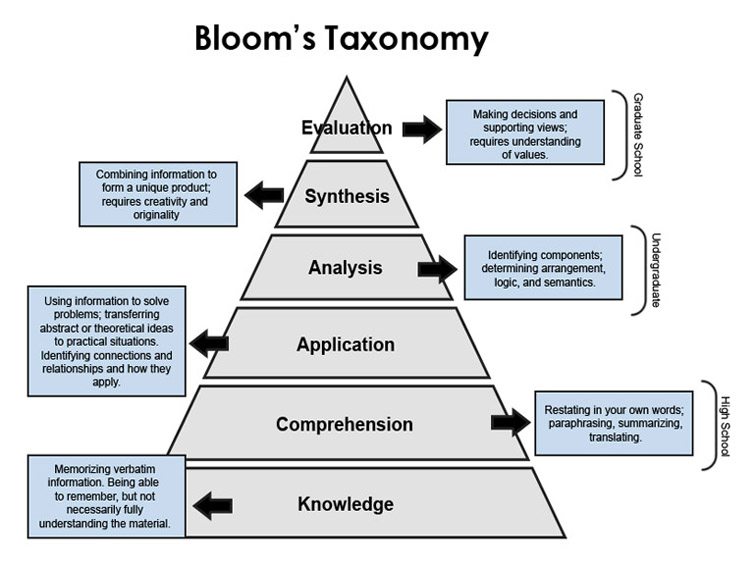
Clear goals, learning outcomes, and teacher and students’ expectations need to be set at the very start of a course. A course outline is not just a set of goals that need to be met by the end of a term, it is a contract that we faculty members must comply with to produce deep and long-lasting learning among learners. A course outline is not written on stone and can be modified to suit one’s teaching style and pupils’ learning preferences. Modifying outline content and expectations by means of a learning outcomes taxonomy such as Bloom’s or Fink’s Taxonomy is a must since we want students to replicate certain behaviors and use knowledge in other different contexts to produce a certain effect to prompt learners to think critically and –why not- out of the box.


Laureate Education Inc. (n.d.). Certificate in Higher Education: Module 1. [Online Certificate].

TeachThought.Com. (2013). Bloom’s Taxonomy. [Infographic]. Retrieved on 2014, Sept. 21 from http://www.teachthought.com/wp-content/uploads/2013/04/BloomsTaxonomySized.jpg


Pronunciation
Development
BIN-02 Pronunciation 1
BIN-06 Pronunciation 2
BIN-04 Reading Skills 1
Reading Skills
Development
BIN-08 Reading Skills 2


Curated Topics
Online
TEFL Daily
ELT Daily
English Language Teaching Journal
Phonemics Daily
The Linguists: Linguistics News
Jonathan’s Learning Attic


Goals for learning from jonacuso


Sunday, September 21, 2014


Sharing Challenges: What we Probably Find in our F2F or Hybrid Teaching

Teaching, Teaching Practices, Teaching Styles 0 comments


Sharing Challenges: What we Probably Find in our F2F or Hybrid Teaching

By Prof. Jonathan Acuña Solano
Thursday, September 16, 2014
Twitter: @jonacuso
Post 144

Reflecting upon my challenges as a college professor over here in Costa Rica, I must confess that a deep change in students’ mind set is needed. This is stated because there are many factors that can influence learners’ success at the university level or a drastic failure for students majoring in any study program. Let us review some of these challenges we all face –from time to time- at our higher level education institutions.

Though I have more than 15 years of experience teaching at the university level, and over 20 years teaching English as a foreign language instructor, it is difficult to change students’ mind set. I cannot say that I am encouraging a “surface” approach to learning among my learners, but this is what I sometimes get to see as their response in class or in the papers they have to write as part of their English Language Teaching major. Because I mostly work with technology in education and literature now, I insist on the importance of reaching higher hierarchical thinking process among my pupils, but some of them are still resilient to accept that learning is in their hands and not in mine.

Students’ mind set is the one challenge I get to face and that prevents them to access deep learning in any college subject. It does take some time for pupils in college to transition from their high school way of studying (surface learning), -at least in my country (Costa Rica)-, which prevents them from moving from a merely memorization-oriented way of studying to a more deeper understanding and reflective way of learning the subject-mattered for each course. When confronted with moving away from that comfort zone, you experience lots of complaints from their part, but in the end, they set their feet out of their comfort zones that –professionally speaking- will not make them succeed in higher education or in ELT.

Some other teaching challenges I face while trying to encourage deep learning with my students can be summarized as follows: 1) Indecision on the part of my students which makes me wonder if they really want to become ELT professionals because teaching is a competency that needs to be developed; 2) Concentration problems due to the Internet and social media, which commonly distract them from the core subject of a lesson; 3) the lack of higher level of concentration due to multiple distractors that students cannot cope with and that makes them shift their attention towards something else; 4) the absence of some sort of participation willingness since learners just expect to be spoon-fed with the info they just need to digest; and 5) their child-raising backgrounds in which the spoon-fed way of studying was strengthened.

These are just immediate challenges for the teacher and for the learner, but how about the professional threats they will eventually face? Let us take a look at the following issue: The need to learn new competencies to excel in this new world full of distraction and distractors. If learners do not learn how to cope with this problem, they are bound to have difficulty to adapt to the demands and needs of the ELT profession (or any other profession) because the learning of new competences is intrinsically connected to the dealing with distractors that can affect performance at work.

Best Teachers Institut. (2010, Sept. 29). What Promotes Deep Learning. Retrieved on 2014, Sept. 16 from http://youtu.be/XvJqNxPwbFM?list=PLaLDibSuk5T7-0wR66byWmA5RDo04koe6

Laureate Education Inc. (2010). Learner Approaches to Learning. [Document included as part of Certificate in Higher Education, Week 1, on their Blackboard LMS]

Learning Teaching. (Atherton, J. S. (2013). Learning and Teaching; Deep and Surface learning [On-line: UK] retrieved 16 September 2014 from http://www.learningandteaching.info/learning/deepsurf.htm


Pronunciation
Development
BIN-02 Pronunciation 1
BIN-06 Pronunciation 2
BIN-04 Reading Skills 1
Reading Skills
Development
BIN-08 Reading Skills 2


Curated Topics
Online
TEFL Daily
ELT Daily
English Language Teaching Journal
Phonemics Daily
The Linguists: Linguistics News
Jonathan’s Learning Attic

Sharing challenges what we probably find in our f2 f or hybrid teaching from jonacuso


Tuesday, September 16, 2014


Older Posts Home
Subscribe to: Posts (Atom)

    Blog Stats

    Blog Stats
    Sunday, August 2, 2026

    Reflective Online Teaching

    Reflective Online Teaching
    Since 2010

    Costa Rica

    Costa Rica
    My Home Country

    +550 Posts and counting

    +550 Posts and counting

    TESOL Certified Instructor

    TESOL Certified Instructor

    Certified Virtual Instructor

    Certified Virtual Instructor

    PD Talks & NCTE-Costa Rica

    PD Talks & NCTE-Costa Rica

    Copyscape

    Protected by Copyscape

    Blog Archive

    • ▼  2026 (69)
      • ▼  August (1)
        • From Isolation to Collaboration: Adapting Communit...
      • ►  July (8)
      • ►  June (5)
      • ►  May (7)
      • ►  April (6)
      • ►  March (15)
      • ►  February (15)
      • ►  January (12)
    • ►  2025 (81)
      • ►  December (10)
      • ►  November (12)
      • ►  October (11)
      • ►  September (10)
      • ►  August (8)
      • ►  July (7)
      • ►  June (6)
      • ►  May (3)
      • ►  April (4)
      • ►  March (6)
      • ►  February (2)
      • ►  January (2)
    • ►  2024 (28)
      • ►  December (3)
      • ►  November (2)
      • ►  October (4)
      • ►  September (4)
      • ►  August (5)
      • ►  July (3)
      • ►  June (2)
      • ►  May (2)
      • ►  April (3)
    • ►  2023 (6)
      • ►  September (1)
      • ►  August (5)
    • ►  2022 (1)
      • ►  July (1)
    • ►  2020 (54)
      • ►  November (4)
      • ►  October (7)
      • ►  September (11)
      • ►  August (15)
      • ►  July (10)
      • ►  April (2)
      • ►  March (5)
    • ►  2019 (13)
      • ►  August (5)
      • ►  July (8)
    • ►  2018 (11)
      • ►  June (2)
      • ►  May (7)
      • ►  April (2)
    • ►  2017 (6)
      • ►  May (2)
      • ►  April (2)
      • ►  January (2)
    • ►  2016 (101)
      • ►  November (4)
      • ►  October (7)
      • ►  September (10)
      • ►  August (4)
      • ►  May (22)
      • ►  April (17)
      • ►  March (21)
      • ►  February (14)
      • ►  January (2)
    • ►  2015 (53)
      • ►  November (5)
      • ►  October (13)
      • ►  August (4)
      • ►  July (8)
      • ►  June (5)
      • ►  May (14)
      • ►  April (4)
    • ►  2014 (40)
      • ►  October (5)
      • ►  September (11)
      • ►  August (4)
      • ►  June (3)
      • ►  May (8)
      • ►  April (5)
      • ►  February (1)
      • ►  January (3)
    • ►  2013 (46)
      • ►  December (1)
      • ►  November (1)
      • ►  October (3)
      • ►  September (5)
      • ►  August (6)
      • ►  July (7)
      • ►  June (6)
      • ►  May (7)
      • ►  April (1)
      • ►  March (4)
      • ►  February (3)
      • ►  January (2)
    • ►  2012 (17)
      • ►  December (3)
      • ►  November (4)
      • ►  October (4)
      • ►  September (6)
    • ►  2011 (5)
      • ►  September (2)
      • ►  August (2)
      • ►  January (1)
    • ►  2010 (46)
      • ►  December (9)
      • ►  November (14)
      • ►  October (3)
      • ►  March (4)
      • ►  February (8)
      • ►  January (8)

    Labels

    • #EdChat (8)
    • #LTTO (14)
    • A Princess of Mars (1)
    • A Tale of Two Cities (1)
    • A Woman fo No Importance (1)
    • A1 Learners (1)
    • ABLA (9)
    • Academic Integrity (1)
    • Academic Research (9)
    • Adaptation (1)
    • Adaptive Expertise (1)
    • Adaptive Learning (1)
    • ADDIE Model (7)
    • Adult Education (3)
    • Adult ELT (1)
    • Adult Learners (3)
    • Adult Learning (2)
    • Adult Online Learning (1)
    • Adventure Fiction (2)
    • Aesthetics (1)
    • Affective Filter (3)
    • Afro-Caribbean Lore (1)
    • Agile Professional Development (1)
    • AI Detection (1)
    • AI Ethics (1)
    • AI in ELT (1)
    • Alberto Delgado Alvarez (1)
    • Aldous Huxley (1)
    • Aldus Huxley (1)
    • Alexander Luria (5)
    • Algorithmic Bias (2)
    • Alienation (2)
    • Ambiguity (1)
    • Analytical Thinking (1)
    • Anansi (1)
    • Ancient Astronaut Theory (1)
    • Ancient Civilizations (1)
    • Ancient Mysteries (1)
    • Andragogy (5)
    • Andy Curtis (1)
    • Angelology (2)
    • Animal Consciousness (1)
    • Animal-Machine (1)
    • António Vieira (1)
    • Aouda (1)
    • Apps for Education (1)
    • Archaeoastronomy (1)
    • Archaeology (1)
    • Archetypal Analysis (1)
    • Archetype (1)
    • Archetypes (1)
    • Archimedes (1)
    • Aristocracy (1)
    • Arsène Lupin (1)
    • Art and Technology (1)
    • Artificial Intelligence (4)
    • Artistic Philosophy in ELT (1)
    • Assessment (12)
    • Assessment in Action (2)
    • Assessment Literacy (1)
    • Assessment Practices (6)
    • ASSURE (1)
    • Asynchronous Tools (2)
    • Attention Span (1)
    • Augustine (1)
    • Aural/oral skills (1)
    • Authenticity (1)
    • autonomous learning (1)
    • Autonomy (1)
    • Bamboo (1)
    • Baroque Thought (1)
    • Barsoom (1)
    • Barthesian Analysis (6)
    • Behavior (1)
    • Being vs. Having (1)
    • Benjamin Button (1)
    • Bergson (1)
    • Bernardo Soares (1)
    • Betrayal (2)
    • Bettelheim (1)
    • Biblical Monotheism (1)
    • Biblical Text Analysis (1)
    • Big Data (6)
    • Bilingualism (1)
    • Biopolitics (1)
    • Blended Learning (1)
    • BlendIt Course (8)
    • Blind Faith (1)
    • Blind Observations (1)
    • Bloom's Taxonomy (5)
    • BNCs (9)
    • Board Work (2)
    • Book Critique (2)
    • Book of Enoch (1)
    • Book of Job (1)
    • Book of Revelation (1)
    • Bookmarking Sites (1)
    • Bourgeois Society (1)
    • Brave New World (1)
    • Brazilian Literature (4)
    • Brazilian Romanticism (2)
    • Breakout Rooms (3)
    • British Council (22)
    • Brotherhood (1)
    • Bureaucracy (3)
    • Burnout Prevention (1)
    • Cain (1)
    • Carl Jung (3)
    • Case Study (4)
    • Catalog of Rubrics (1)
    • Catastrophism (1)
    • Catholic Storytelling (1)
    • CEF (2)
    • CEFR (1)
    • CEFR-Aligned Assessment (1)
    • Centro Universitario de Desarrollo Intelectual (1)
    • Character Analysis (3)
    • Character Development (1)
    • Characterization (3)
    • Charles Dickens (1)
    • Christian Demonology (1)
    • Civil Obedience (1)
    • Civilization (1)
    • Classical Biography (1)
    • Classical Literature (1)
    • Classroom Interaction (2)
    • Classroom Management (8)
    • Classroom Organization (1)
    • Classroom Practice (1)
    • Classroom Routines (1)
    • Cloud Reader (1)
    • CLT (6)
    • Coaching (1)
    • Coaching in Teacher Classroom Observation (2)
    • Code of Ethics (1)
    • Cognition (1)
    • Cognitive Load (1)
    • Collaboration (1)
    • Collaborative Learning (1)
    • Collaborative Noticing (1)
    • Collectivism (1)
    • Colombian Poetry (1)
    • Color Motifs (1)
    • Communicating about Uncertainty (1)
    • Communicative Competence (4)
    • Communicative Language Teaching (7)
    • Communities of Practice (3)
    • Community of Practice (8)
    • Comparative Mythology (2)
    • Comparative Religion (2)
    • Comparative Studies (1)
    • Competency-Based Learning (9)
    • Conformity (2)
    • Conformity Pressure (1)
    • Connectivism (1)
    • Conscience (3)
    • Constructive Alignment (1)
    • Constructivism (1)
    • Contemporary Aesthetics (1)
    • Contemporary Short Fiction (1)
    • Content Assimilation (1)
    • Content Design (1)
    • Cooperative Learning (2)
    • CoP (3)
    • Corrective Feedback (4)
    • Cosmology (1)
    • Costa Rica (2)
    • Costa Rican Literature (1)
    • Course Project (2)
    • Coursebook Adaptation (1)
    • Creative Agility (1)
    • Creativity (1)
    • Critical reflection (1)
    • critical skills (1)
    • Critical Thinking (1)
    • Critical Thinking Skills (2)
    • Cultural Allegory (1)
    • Cultural Assimilation (1)
    • Cultural Centers (1)
    • Cultural responsiveness (1)
    • Culture (12)
    • Culture Framework (2)
    • Culture Teaching (8)
    • Curriculum Design (3)
    • Curriculum Development (7)
    • Custom eLearning (2)
    • Custom Training (1)
    • Dante Alighieri (2)
    • Dante Studies (2)
    • Darwinism (1)
    • Data Science (7)
    • Data-Driven Teaching (5)
    • Data-Informed Leadership (1)
    • David Fincher (1)
    • DDT (1)
    • Death (1)
    • Deborah Tannen (1)
    • Decadence (1)
    • Deductive Grammar Instruction (2)
    • Deep Ecology (1)
    • Dehumanization (1)
    • Demonology (2)
    • Demonology and Devil-Lore (2)
    • Demythologization (1)
    • Deontology (2)
    • Desire (3)
    • Determinism (1)
    • Developmental Feedback (1)
    • Dialogism (1)
    • Diane Larsen-Freeman (1)
    • Dictator (1)
    • Didactics (4)
    • Differentiation (4)
    • Digital Culture (1)
    • Digital Inequality (1)
    • Digital Pedagogy (2)
    • Digital Resources (1)
    • Dignity (1)
    • Dino Buzzati (1)
    • Discourse Analysis in ELT (1)
    • Distance Education (2)
    • Dreams (1)
    • Dualism (1)
    • Dysfunctional Families (1)
    • Dystopia (2)
    • Dystopian Fiction (1)
    • Dystopian Society (1)
    • E-Portfolios (1)
    • Eça de Queirós (11)
    • Eco-Criticism (1)
    • Edgar Rice Burroughs (3)
    • Education (1)
    • Education and Learning (34)
    • Education Policy (2)
    • Education Technologies (9)
    • Educational Evolution (1)
    • Educational Leadership (1)
    • Educational Philosophies (1)
    • EFL/ESL Activities (1)
    • El Clis de Sol (1)
    • eLearning (1)
    • Electracy (1)
    • ELF (1)
    • Elicitation (1)
    • ELL (17)
    • Elohim (3)
    • Elora Hary (1)
    • ELT (64)
    • ELT Conference (1)
    • ELT Institutions (1)
    • ELT Leadership (1)
    • ELT Methodology (1)
    • ELT Pedagogy (2)
    • ELT Professional Development (3)
    • ELT. Teacher Growth (1)
    • Emotional Intelligence (1)
    • Emotional Literacy (2)
    • Emotional Repression (1)
    • Empathy (1)
    • English Grammar (3)
    • English Language Teaching (15)
    • English Teaching (1)
    • Enkidu (1)
    • Environmental Destruction (1)
    • Environmental Philosophy (1)
    • Envy (1)
    • Epistemology (1)
    • Equity (1)
    • Eric Mazur (1)
    • Erich Fromm (4)
    • Error Correction (2)
    • Escape from Freedom (1)
    • Eschatology (1)
    • Esotericism (1)
    • ESP (2)
    • Ethical Inaction (1)
    • Ethical Judgment (1)
    • Ethical Judgments (1)
    • Ethical Leadership (1)
    • Ethical Sacrifice (1)
    • Ethics (47)
    • Ethics Analysis (2)
    • Ethics Education (1)
    • Ethics of Care (1)
    • Etiological Storytelling (1)
    • Evaluating Digital Tools (1)
    • Evaluation (4)
    • Evil (1)
    • Evolution (1)
    • Executives' School (9)
    • Existentialism (1)
    • Ezekiel (1)
    • F. Scott Fitzgerald (1)
    • Fairy Tales (2)
    • Faivre (1)
    • False Positives (1)
    • Fantastic (2)
    • Fatalism (2)
    • Fear (1)
    • Feedback (5)
    • Female Identity (1)
    • Fernando Pessoa (1)
    • Flipped Classroom (1)
    • Flipped Learning (1)
    • Focus on Form (1)
    • Folklore (1)
    • Formative Assessment (5)
    • Forums (1)
    • Fossilization (1)
    • Frames-Based Teaching (1)
    • Framing in Discourse (1)
    • Frankenstein (1)
    • Franz Kafka (1)
    • Freedom (1)
    • French Literature (2)
    • Freudian Analysis (3)
    • From theory to practice (2)
    • Frommian Analysis (2)
    • Fulfillment (1)
    • Future for Education? (2)
    • Gabriel Escorcia Gravini (1)
    • Gamification (1)
    • Genesis (1)
    • George Orwell (1)
    • George Sand (1)
    • Global Competence (1)
    • Global Ethics (7)
    • Gnosticism (1)
    • Gothic Literature (1)
    • Gothicism (1)
    • Grading Ranges (1)
    • Graham Hancock (1)
    • Grammar (3)
    • Greed (1)
    • Group Dynamics (2)
    • Group Work (2)
    • Guest Author (1)
    • Guided Practice (2)
    • Guilt (1)
    • H. G. Wells (1)
    • H.P. Lovecraft (3)
    • Haiku (2)
    • Hanegraaff (1)
    • HD Brown (1)
    • Hebrew Mythology (1)
    • Hermeticism (2)
    • Hero's Journey (1)
    • Hero’s Journey (1)
    • Hesitation (1)
    • Higher Education (49)
    • Higher Education Ethics (1)
    • Historical Context (1)
    • Historical–Biographical Criticism (1)
    • History (2)
    • Holistic Education (1)
    • Homer (1)
    • Homerton College Cambridge Course (2)
    • Hootcourse (1)
    • Horacio Quiroga (1)
    • Human Dignity (1)
    • Human Rights (1)
    • Human-Centered Narrative (1)
    • Human-Centered Pedagogy (1)
    • Humanistic Morality (1)
    • Humanity (1)
    • Hybrid and Blended Learning (61)
    • Hybrid In-person Teaching (1)
    • Hybrid Learning Models (1)
    • Ice Age (1)
    • Identit (1)
    • Identity (2)
    • Ideology (3)
    • Idioms (1)
    • Iktomi (1)
    • Imagery (2)
    • Inclusive Education (1)
    • Inclusive Pedagogy (2)
    • Independent Practice (1)
    • Indianism (1)
    • Indigenous Heroism (1)
    • Individuation (3)
    • Inductive Grammar Instruction (2)
    • Inferno XXXIII (1)
    • infographic (1)
    • Institutional Culture (1)
    • Institutional Improvement (1)
    • Institutional Memory (1)
    • Instruction-Giving (1)
    • Instructional Design (4)
    • Integration of Technology into Teaching (10)
    • Interaction (1)
    • Interaction Patterns (2)
    • Intercultural Awareness (1)
    • Interdisciplinary Inquiry (1)
    • Interlanguage (2)
    • Intertextuality (1)
    • Interventions in ELL (1)
    • Irony (4)
    • Isaac Asimov (1)
    • Issus (1)
    • Italian Literature (1)
    • Jacqueline Alves Souza (1)
    • Jacques de Molay (1)
    • Jacques Lacan (4)
    • James Knowles (1)
    • James Thurber (1)
    • Japanese Folklore (1)
    • Jehovah (1)
    • Jeremiah (1)
    • Jewish Apocalypticism (1)
    • Jewish Mysticism (1)
    • John Carter (3)
    • José de Alencar (2)
    • JotForm (1)
    • Journey (1)
    • Journey to the Center of the Earth (1)
    • Jules Verne (3)
    • Jungian Analysis (9)
    • Just-in-Time Training (1)
    • Kabbalah (1)
    • Kahlil Gibran (2)
    • Kathleen M. Bailey (1)
    • Kazinczy (1)
    • Kindness (1)
    • King Arthur and his knights (1)
    • Kirkpatrick Model (15)
    • Knight Templars (1)
    • Knowledge (1)
    • Kurt Vonnegut (1)
    • La gran miseria humana (1)
    • La Insolación (1)
    • Lacan (1)
    • Lacanian Analysis (7)
    • Lacanian Psychoanalysis (1)
    • Language (1)
    • Language Competences (1)
    • Language Education (2)
    • Language Institutions (1)
    • Language Learning (15)
    • Language Series Comparative Analysis (1)
    • Language Teaching (9)
    • Latin American Literature (3)
    • Laureate Course Module 3 Teaching with Technology (19)
    • Laureate Educator (4)
    • Laureate Educator in the XXI Century (2)
    • Laureate Educator-Week 1 (1)
    • Laureate Educator-Week 2 (1)
    • Laureate Educator-Week 3 (1)
    • Le Drac (1)
    • Leadership (10)
    • Learner Agency (1)
    • Learner Anxiety (1)
    • Learner Attention (1)
    • learner autonomy (5)
    • Learner Confidence (1)
    • Learner Diversity (3)
    • Learner Engagement (1)
    • Learner Grouping (2)
    • Learner Uptake (1)
    • Learner-Centered Instruction (2)
    • Learner-Centered Pedagogy (1)
    • Learner-Centeredness (1)
    • Learning (8)
    • Learning Activities (1)
    • Learning Analytics (1)
    • Learning Objectives (2)
    • Learning Preferences (1)
    • Learning Styles (1)
    • Learning Technologies (1)
    • Leopoldo Lugones (1)
    • Les Demoiselles d’Avignon. Pablo Picasso (1)
    • Lesson Closure (1)
    • Lesson Design (2)
    • Lesson Openings (1)
    • Lesson Planning (6)
    • Lev Vygotsky (4)
    • Libraries (1)
    • Life is a Dream (1)
    • Life Stories (1)
    • Linguistics (2)
    • Listening (1)
    • Literary Analysis (8)
    • Literary Criticism (28)
    • Literary Ethics (1)
    • Literary Psychology (1)
    • Literature (36)
    • Livro do Desassossego (1)
    • LMS (6)
    • Lord’s Prayer (1)
    • Lost Civilization (1)
    • LOTI Profile (5)
    • Love (2)
    • Lycurgus (1)
    • Machado de Assis (2)
    • Machiavellian Narration (1)
    • Mãe (1)
    • Magón (1)
    • MakerSpace (1)
    • Manuel González Zeledón (1)
    • Marcel Duchamp (6)
    • Marcellus (1)
    • Marxist Literary Approach (1)
    • Mary Shelly (1)
    • Materials Design (1)
    • Materials Development (3)
    • Maurice Leblanc (1)
    • Meaning of Justice (1)
    • Megalithic Architecture (1)
    • Melodrama (1)
    • Mentalism (1)
    • Mentorship (1)
    • MEP (Ministerio de Educación Pública) (1)
    • Metacognition (3)
    • Metadata (1)
    • Metalinguistic Feedback (1)
    • Metaphor (1)
    • Metaphysics. Self-Mastery (1)
    • Methodology (3)
    • Micro-Ethics (1)
    • microcelebrities (1)
    • Microlearning (1)
    • Mimetic Desire (1)
    • Mind Maps (2)
    • Mindfulness (12)
    • Misogyny (1)
    • Mistake vs. Error (1)
    • Mixed-Ability Classes (1)
    • Mixed-Methods Research (4)
    • Mobile Learning (1)
    • Modeling in ELT (1)
    • Modern Realism (1)
    • Modernity (3)
    • Modular Learning (1)
    • Moncure Daniel Conway (5)
    • MOOCs (1)
    • Moodle (5)
    • Moral Agency (1)
    • Moral Allegory (1)
    • Moral Biography (1)
    • Moral Cannibalism (1)
    • Moral Education (1)
    • Moral Failure (1)
    • Moral Lesson (1)
    • Moral Philosophy (2)
    • Moral Responsibility (2)
    • Moral Theology (2)
    • Moral-Humanistic Criticism (1)
    • Morality (2)
    • Motherhood (1)
    • Motivation (3)
    • Multimedia Learning (1)
    • Music and Learning (1)
    • Myth (1)
    • Myth Interpretation (1)
    • Myth of Evil (1)
    • Mythic Narrative (1)
    • Mythological Archetypes (1)
    • Mythology (3)
    • Narrative (1)
    • Narrative Distance (1)
    • Narrative Empathy (1)
    • Narrative Irony (1)
    • Narrative pedagogy (1)
    • Narrative Structure (5)
    • Narrative Voice (1)
    • Nature (1)
    • Nature Spirits (1)
    • Necropolitics (1)
    • Needs Assessment (3)
    • Netiquette (1)
    • Network Community (1)
    • NGL (1)
    • Nicaraguan Literature (2)
    • Nicatesol (1)
    • Nietzsche (1)
    • Nive Events of Instruction (1)
    • Nonviolent Communication (6)
    • ñor Cornelio Cacheda (1)
    • Noticing (1)
    • Noticing Hypothesis (2)
    • Nouns in English (1)
    • Novice Teachers (3)
    • Nudos (1)
    • O Mandarim (2)
    • Objective Writing (1)
    • Odysseus (1)
    • OER (1)
    • Off-the-Shelf Learning (1)
    • Online Community (1)
    • Online EFL (1)
    • Online Instruction (55)
    • Online Language Teaching (2)
    • online learning (50)
    • Online Learning Programs (1)
    • Online Persona (9)
    • Online Program Design (1)
    • online teaching (9)
    • Online Teaching Approach (1)
    • Online Teaching Practices (72)
    • Oral Assessment (1)
    • Oral Communication (1)
    • Oral Skills (2)
    • Organizational Learning (1)
    • Orientalism (1)
    • Origins (1)
    • Oscar Wilde (1)
    • Output Hypothesis (1)
    • Padre Luis Coloma (1)
    • Paideia (1)
    • Paper.li (1)
    • Pasolini (2)
    • Passepartout (1)
    • Pater Noster (1)
    • Paul of Tarsus (1)
    • Paz a los muertos! (1)
    • PBL (1)
    • PD (2)
    • Peace to the Dead! (1)
    • Pedagogy (2)
    • Pedro Calderón de la Barca (1)
    • Peer Correction (1)
    • Peer Instruction (1)
    • Penitence (1)
    • Penny Ur (2)
    • Persona (2)
    • Personal Learning Networks (2)
    • Pessimism (1)
    • Phileas Fogg (1)
    • Philip K. Dick (1)
    • Philosophy (1)
    • Phonemics (4)
    • Phonetics (4)
    • Phonotactics (3)
    • Pilot Programs (1)
    • PLEs and PLNs for Lifelong Learning Competencies Week 1 (1)
    • Plot Analysis (2)
    • Plutarch (6)
    • Poetry (2)
    • Poetry Analysis (1)
    • Political Discourse (1)
    • Political Heroism (1)
    • Political Terminology (1)
    • Popol Vuh (1)
    • Population Control (1)
    • Portuguese Literature (3)
    • Portuguese Realism (1)
    • Postcolonialism (1)
    • Posthumanism (1)
    • Prehistory (1)
    • Pride (1)
    • Procrustean Syndrome (1)
    • Produsage (1)
    • Produser (1)
    • Professional Capital (2)
    • Professional Competencies (1)
    • Professional Development (11)
    • Professional Growth (1)
    • Professional Identity (2)
    • Projec-Based Learning (1)
    • Promethean Myth (1)
    • Pronunciation (7)
    • Psychoanalysis (2)
    • Psychological Analysis (1)
    • Psychological Punishment (1)
    • Psychological Resilience (1)
    • Psychological Transformation (1)
    • Psychology (1)
    • Public Speaking (1)
    • Purgatorio XI (1)
    • Qualitative Research (4)
    • Quantitative Research (4)
    • Quest (1)
    • Rapport (2)
    • rationality (1)
    • Reading (1)
    • Reading and Vocabulary (2)
    • Realism (3)
    • Recasts (1)
    • Reception Theory (1)
    • Recruitment (1)
    • Recycling in Education (1)
    • Reflective Communities (1)
    • Reflective Evaluation (2)
    • Reflective Journaling (5)
    • Reflective Practice (23)
    • Reflective Reading (1)
    • Reflective Teacher Communities (1)
    • Reflective Teacher Leadership (1)
    • Reflective Teaching (60)
    • Religion (1)
    • Religious Authority (1)
    • Religious Critique (1)
    • Religious Evolution (1)
    • Research (9)
    • Resilience (3)
    • Resource Adaptation (1)
    • Responsibility (1)
    • Return on Investment (1)
    • Richard Schmidt (2)
    • Risk Communication (1)
    • Robert Frost (1)
    • Robert Gagné (2)
    • ROI (1)
    • ROI in ELT (1)
    • Roland Barthes (3)
    • Roman Conquest (1)
    • Roman Offices (1)
    • Roman Republic (1)
    • RTC (1)
    • Ruben Puentedura (1)
    • Rubric-Based Planning (1)
    • Rubrics (3)
    • Samael (1)
    • SAMR Model (1)
    • Sanctity (1)
    • Scaffolding (3)
    • Schema (1)
    • Scholasticism (1)
    • Science Fantasy (1)
    • Science Fiction (2)
    • Science Fiction Studies (1)
    • Scoop.it! (1)
    • Second Language Acquisition (5)
    • Secret Societies of the Middle Ages (1)
    • Self-Fulfilling Prophecy (1)
    • Semantic Change (1)
    • Semiotics (2)
    • Sentence Patterns (1)
    • Sermão de Santa Teresa (1)
    • Shadow (3)
    • Short Films (1)
    • Short Stories (4)
    • Short Story Analysis (1)
    • Simplicity (1)
    • Sioux Legends (3)
    • Sir Gareth (1)
    • Sir Gawain (1)
    • Sir Lancelot (1)
    • Sir Tristam (1)
    • Skepticism (1)
    • Sketchpads (1)
    • Skill Gap Analysis (1)
    • SLA (4)
    • Slavery in Brazil (1)
    • Social Agency (1)
    • Social Criticism (1)
    • Social Critique (2)
    • Social Language (3)
    • Social Media (29)
    • Social Networking in Education (3)
    • Social Perception (1)
    • Social Satire (1)
    • Social Transformation (1)
    • Sociocultural Theory (1)
    • Son of Man (1)
    • Sparta (1)
    • Speaking (1)
    • Speaking Scenarios (1)
    • Stephen Krashen (1)
    • Sticky Curriculum (1)
    • Storytelling (1)
    • Strategies for online teaching (2)
    • Student Agency (1)
    • Student Assessment (1)
    • Student Engagement (1)
    • Student Interest (3)
    • Student Motivation (2)
    • Student Talk Time (1)
    • Student Tips (2)
    • Subjectivity (1)
    • Sumerian (1)
    • Summative Assessment (2)
    • Supernatural (1)
    • Supernaturalism (1)
    • Supervision (1)
    • Supplementary Materials (1)
    • Sustainability (2)
    • Symbolic Philosophy (1)
    • Symbolism (5)
    • Synchronous Online Teaching (1)
    • Syntax (2)
    • Syracuse (1)
    • Task-Based Instruction (1)
    • Task-Based Language Teaching (1)
    • Task-Based Learning (1)
    • TBI (1)
    • TBLT (3)
    • Teacher Agency (3)
    • Teacher Cognition (1)
    • Teacher Correction (1)
    • Teacher Development (25)
    • Teacher Education (1)
    • Teacher Evaluation (2)
    • Teacher Feedback (2)
    • Teacher Identity (2)
    • Teacher Inquiry (1)
    • Teacher Mentoring (2)
    • Teacher Mentorship (1)
    • Teacher Observation (1)
    • Teacher Professional Development (2)
    • Teacher Reflection (2)
    • Teacher Training (5)
    • Teacher Well-being (4)
    • Teacher Well-Being. Kirkpatrick Model (1)
    • Teacher–Student Relationships (1)
    • Teaching (47)
    • Teaching Adolescents (1)
    • Teaching Aids (1)
    • Teaching ePortfolio (1)
    • Teaching Grammar (2)
    • Teaching Models (1)
    • Teaching Online (9)
    • Teaching Philosophy (4)
    • Teaching Portfolio (1)
    • Teaching Practices (49)
    • Teaching Practicum (22)
    • Teaching Presence (2)
    • Teaching Styles (8)
    • Teaching Tips (9)
    • Teaching With Technology (4)
    • Teaching With Technology-Week 1 (1)
    • Teaching With Technology-Week 2 (1)
    • Teaching With Technology-Week 3 (2)
    • Teaching With Technology-Week 4 (4)
    • Teaching With Technology-Week 5 (3)
    • Teaching With Technology-Week 6 (2)
    • Teaching With Technology-Week 7 (3)
    • Teaching With Technology-Week 8 (2)
    • Teaching With Technology-Week 9 (1)
    • Tech Tip (5)
    • Technocriticism (1)
    • Technological Assessment (2)
    • Technology Use Tips (1)
    • TED (1)
    • Templars (1)
    • Temporal Paradox (1)
    • Temporality (1)
    • Temptation (2)
    • Teodoro (1)
    • Testing (1)
    • The Art of Loving (1)
    • The Assassins (1)
    • The Book of Proverbs (1)
    • The Butterfly Circus (1)
    • The Cats of Ulthar (1)
    • The Data Scientist (5)
    • The Epic of Gilgamish (1)
    • The Gods of Mars (1)
    • The Kybalion (2)
    • The Loincloth (1)
    • The New Normal (1)
    • The Noticing Hypothesis (2)
    • The Outsider (1)
    • The Prophet (2)
    • The Real (1)
    • The Road Not Take (1)
    • The Skull (1)
    • The Time Machine (1)
    • Theater Criticism (1)
    • Themistocles (1)
    • Theophoric Names (1)
    • Theseus (1)
    • Thomas Keightley (2)
    • Thomistic Ethics (2)
    • Thomistic Grace (1)
    • Timing of Correction (1)
    • Todorov (1)
    • Tolkien (1)
    • Transformation (1)
    • Trickster (1)
    • Trinity (1)
    • Turnitin (1)
    • Tzvetan Todorov (1)
    • UCC (1)
    • Ugarit (1)
    • Ugolino (1)
    • Universidad Mariano Gálvez (2)
    • Unreliable Narration (1)
    • Unreliable Narrator (1)
    • Utilitarianism (2)
    • Vengeance (1)
    • Videoconferencing Platforms (1)
    • Virtual Classroom Features (1)
    • Virtual Classroom Management (1)
    • Virtual Classrooms (1)
    • Virtual Learning Environments (8)
    • Virtual Teaching (5)
    • Virtualized Teaching (1)
    • Virtue (1)
    • Visual Literacy (1)
    • Visual Scaffolding (1)
    • VLE (47)
    • VLEs (38)
    • Vocabulary learning (10)
    • WAS (14)
    • Wealth (1)
    • Web 2.0 (4)
    • Web search engine options (1)
    • Web Tools (6)
    • WebQuests (1)
    • Western Esotericism (1)
    • Western Mysticism (1)
    • Wilbert Salgado (12)
    • William Elliot Griffis (1)
    • Willingness to Communicate (1)
    • Working Adult Student (5)
    • Workplace Dynamics (1)
    • writing (2)
    • Writing Skills (1)
    • Yahweh (1)
    • Yzur (1)
    • Zecharia Sitchin (1)
    • Zone of Proximal Development (1)
    • ZPD (1)

Copyright © All Rights Reserved. Reflective Online Teaching | Converted into Blogger Templates by Theme Craft