skip to main | skip to sidebar
Reflective Online Teaching
My Personal Site for Reflective Teaching
RSS
    Jonathan Acuña Solano, Post Author
    Contact Email: jonacuso@gmail.com

Showing posts with label #LTTO. Show all posts

Teaching Online “Long-Deserved” Capstone

#LTTO, Online Instruction, online learning, Online Teaching Practices 0 comments

Teaching Online “Long-Deserved” Capstone
The wonders of reflective journaling in online teaching

By Prof. Jonathan Acuña-Solano
School of English
Faculty of Social Sciences
Universidad Latina de Costa Rica
Tuesday, February 23, 2016
Post 219

         Throughout my Online-Hybrid-Blended Education training, I have examined a variety of strategies and tools along with associated benefits and challenges when teaching in online courses. Many of these have been used now that I am an online instructor for Laureate’s Faculty Development’s portal for faculty members of any of the Laureate universities across the world. Additionally, I have started to use them in my blended learning courses at Universidad Latina, a Laureate sister university in Costa Rica, with lots of success and deep learning among my many students.

         My progressive training in every single module proposed for the Online, Hybrid, and Blended Education certificate offered by Laureate’s Faculty Development has made me encounter lots of benefits and challenges regarding virtual learning environments. I have come to experience the benefits of the flexibility and availability of creating or finding multimedia, of working conscientiously on instructional design with various models of development, of having to deal with the challenges of technical issues that directly or indirectly affect me as an instructor or my students, and of motivating and engaging learners online to develop real deep learning that can trigger –in them- the development of skills and competences for their jobs.

         When I look back in time, in an act of hindsight tinted with mindfulness, I see myself answering these questions and I also invite you to ask yourself:

·         While facilitating the first week of your Module, think about your experiences, and if it is what you expected in terms of student interaction and workload.

While facilitating the first week of my first Module as an online instructor, several things whirled around my mind that needed to be written down. On the one hand, in terms of student interaction, and working on this exercise from a metacognitive perspective, it was what I had been expecting to happen. The early birds arrived before the course started to see what needed to be completed, and by mid-week, several of the “owls” were still resting in their “branches.” As an instructor I am not going to criticize this particular behavior, but what needs to be highlighted is that teaching faculty when behaving like students, they embody what we criticize from our learners’ way of conducting their academic studies: a bit of procrastination.

     In terms of workload, I can say that it did not differ much from the hybrid courses I had been empirically teaching for the last three years at Universidad Latina in Costa Rica. My whole experience as an instructor in terms of feedback, for instance, was quite similar to what I like to do with my current students: Challenge them a bit more with a “burning question” in regards to what they are sharing and contributing with the course and content, but encourage them to expand their ideas much more to really speak up their minds. But as in my regular hybrid courses in college, my Module students were not exactly that responsive. And with this, I went back to my previous thought: Teaching Faculty do behave like learners when they are the students and replicate the very same behaviors we all instructors complain about in terms of procrastination and course engagement.

     Being a bit open-minded with the insights gained so far, I am a defender of blended education as a way to help students acquire and build their knowledge for their current majors and/or future careers. However, the big gap that I still find, even among teaching faculty taking professional development courses, between intrinsic and extrinsic motivation. Many of these course are taking by teaching professionals out of a “compromise” they have with a higher education institution (extrinsic) rather from the fact that they want to become better at teaching by learning new techniques and sharing their experiences while using those techniques. This is for me what the real challenge is. As an instructor, on a hybrid setting or on a F2F classroom, I always feel excited and find passion for what I like to do, to teach; nevertheless, I do not usually encounter those very same emotions in students or other colleagues.

     To sum up, and thinking of questions that assault me in my teaching endeavors, I must pose the following:
a)   How can online courses be marketed to have the students who are really interested in learning and developing their potential?
b)   How can online instructors motivate their students to go beyond the extra mile and not restrict themselves to the minimum effort?
c)   What about teaching assistantship? Should there be some many assistants bombarding learners? Wouldn’t it have been better to just have a couple rather than a whole bunch?
Facilitating an online learning space with highly interested and motivated students is just fun and rewarding, but it all depends on how all factors unfold along the course to see how much fun it can really be.

·         Reflect on any insights gained as well as the benefits and challenges that you and your Module participants may have encountered. Be sure to consider achievements and successes that you or your students had during this week.

I can’t really tell how much time should be devoted to one’s online course facilitation but use some sort of a formula, depending on what kind of online task students are to develop: Daily Monitoring + Timely Feedback + Grading + others. Timewise, course facilitation may account for some 10 to 15 minutes per student in class, and this also be affected by the quality of work done by learners: It can be more or luckily less than 10 minutes to really guide your students.

What else would I consider? Though I cannot label myself as a fully-grown and seasoned online professional, the fact is that this dedication of time to one’s online learners is very important. Not that far in time, I started getting emails from some of my students in Asia thanking and encouraging me for my way of facilitating the course. That is, they were grateful for the individualized guidance and comments provided to them, something they had not experienced before. Moreover, they were thankful for having me share my points of view, as another participant, in the forum discussions we had as part of the courses I get to teach. Being a bit mindful, the human connection we can create with online learners is as vital as the one we develop with learners in a F2F teaching environment. For me, this has been one of the best pieces of washback one can get in facilitating an online course.


Tuesday, February 23, 2016


Online Trends and Advanced Tools

#LTTO, Hybrid and Blended Learning, Online Instruction, online learning, Online Teaching Practices, VLE, VLEs 0 comments

Online Trends and Advanced Tools
A community of practice reflection
Revisted!

By Prof. Jonathan Acuña-Solano
School of English
Faculty of Social Sciences
Universidad Latina de Costa Rica
Sunday, February 21, 2016
Post 216

As one progresses in the exploration of asynchronous tools for online courses, it is very important to evaluate how these tools can eventually affect the learning environment one is trying to create for one’s learners. This exploration of potential challenges takes us to examine the process of creating wikis, blogs, or a simple video message for one’s learners. Nevertheless, in spite of the challenges one can face, there are potential benefits that one is to identify in the usage of any of these tools.

Let us explore the challenges, benefits, and questions one may have concerning asynchronous tools for online courses. Here are reproduced three questions regarding tools that I intend to answer based on my current teaching. Nevertheless, it is also for you, my reader, to ask yourself the very same questions and reflect upon them, too.

·         What do you feel is the most challenging feature of asynchronous tools?

When confronted with trying to give an answer to this question, I can barely think of an appropriate answer. The point I am trying to make in terms of challenges can be directly connected to the instructor or to the learner. At the beginning the neophyte teacher can find him/herself in a dead-on street if help is not asked from some experienced users of the tool(s) s/he wants to use in his/her online or hybrid course. As soon as this shocking experience is over and expertise and confidence are gained, the instructor is even ready to help students use the desired tool. At this point, the teacher is to train learners on how to use a given tool, so they can also gain confidence in its use and become effective users of the tool.

To put it simple, teachers can find it difficult at the beginning, but as soon as they get the knack of how something is made, they are on the go. As for students, who are more technologically oriented, the transition to start using a new tool can be just a matter of a short lapse but with proper and effective training.

·         What do you feel is the greatest benefit of these tools?

Asynchronous tools benefit today’s learners beyond what can be really measured. Firstly, tools like these provide a certain kind of freedom that working students cannot experienced due to their tight schedules. With asynchronous tools, they can find some room in their busy agendas to do what is requested in the course chronogram. Secondly, it terms of m-Learning, these tools offer them the chance of working on their assignments while commuting back and forth from home to work. With their mobile devices they are also aligned with the course content and with the teacher’s feedback and new materials.

With tools like these, we need to stop being skeptical and understand that blended and mobile learning can be ideal ways of earning a degree, as it already happens around the globe and in which thousands of individuals are part of this way of learning. Asynchronous tools provided by the course instructor are the last ingredient needed to help all these students to get a university degree or additional training for their working life.

·         What questions do you still have about using asynchronous tools in your online course?

When asked the above question, I must admit that I have already overcome my initial skepticism of online, hybrid, and blended learning. I feel certain that education can be attained in different ways, and that our technological societies and citizens are looking for extra alternatives that can allow them to work, have a family, enjoy their social life, and also get a degree in a higher education institution. The use of all these asynchronous tools connected to an LMS platform can be the long-awaited answer that many individual in our home countries have been waiting for.

To conclude, as suggested above, ask yourself the same questions provided here. I am sure we can have either similar or different answers due to our personal teaching conditions and settings. Blended learning at Universidad Latina where I am currently working is still in a very developing stage. It is not a common practice in all courses where more traditional ways of teaching are still favored by many faculty members. With the pass of time, it is bound to be a slow but forceful revelation in education at the higher level, and more and more professors will start joining those of us who already combine F2F instruction with lots of blended activities to have learner exposed to class content beyond the classroom boundaries.


Sunday, February 21, 2016


Social Bookmarking: Why to Do it

#LTTO, Hybrid and Blended Learning, Online Teaching Practices 4 comments


Managing Online Resources
Social Bookmarking: Why to Do it

By Prof. Jonathan Acuña Solano
Sunday, November 8, 2015
Twitter: @jonacuso
Post 207

          Though I had been keeping Web sites that I found and considered useful in an email folder, I was fortunately introduced to social bookmarking about 8 years ago when I was taking a course with the University of Oregon (UO). As a way to keep track of all those great Webpages one gets to run into while browsing for information for my language courses and for one’s research papers, our UO instructors asked us to open an account at http://www.delicious.com. Later on, a colleague of mine, Stephen Thergesen, an English teacher based in Denver, Colorado, introduced me to http://www.paper.li, and by means of that site I was able to “fatten” my Delicious account with more useful sites for my teaching, research interests, and life-long learning.


          I must confess that I have somehow neglected my Delicious account because I found, thanks to Stephen Thergesen –again-, another much more dynamic site to keep track of my Internet findings: http://www.scoop.it. But anyhow, those sites are now part of my daily professional life and sharing with my college students. And how have I been using them with my university students? Let me share a couple of ideas with you:

1
Bookmarking in language classes
·         To list webpages for language practice aiming at working with vocabulary or grammar structures
·         To have a list of monolingual dictionaries and thesaurus for writing tasks or reading exercises
2
Bookmarking in content classes
·         To keep track of webpages for research purposes: speeches, papers, WebQuests, etc.
·         To keep record of pages that can be eventually used in one’s teaching practicum

          There are more benefits than challenges in terms of encouraging students to sign up for a bookmarking account. In terms of educational benefits, students will take advantage of social bookmarking by keeping a record of pages they can really profit from. Anything they get to find online and that they consider useful for their future professional practicum and later on practice, it is a plus for all students. It will be up to them to keep on adding more and more sites to their bookmarks to keep themselves current and updated with the new trends in their fields.

          The challenge of keeping a social bookmarking account is not connected to an instructor, but it is more linked to the students. As a language teacher I am much into sharing stuff I find on my regular browsing through the Web and enjoy sparing those sites with my pupils, but it is in the end the learners’ decision to keep on feeding their bookmarks and sharing them with their peers. And the only way to mitigate that is by having students regularly share their findings in a link-sharing section that might be curated by all learners as a wiki.


Sunday, November 08, 2015


Reflection: Comparing Experiences with Other Faculty Members at a Different Laureate University

#LTTO, Hybrid and Blended Learning, Teaching Practices 0 comments


Reflection: Comparing Experiences with Other Faculty Members at a Different Laureate University

By Prof. Jonathan Acuña Solano
Saturday, November 7, 2015
Twitter: @jonacuso
Post 206

          By comparing my online, hybrid, blended learning/teaching experiences with other colleagues, I feel honored to share a bit of what I have gotten to know with them. Though I cannot consider myself a fully-developed online instructor, my empirical work for more than seven years so far is giving me a different standpoint in terms of training and my LoTi (Levels of Technology Integration) level (LOTI Levels of Technology Integration, n.d.). I have –several times- suggested colleagues of mine and other faculty members to get to know the LoTi Profiles to self-evaluate themselves and to get to know a bit more of their students. Just because our student seem to be 21st Century learners, it does not really mean they are at that technological level to embark themselves into online learning.

          When I compare my experiences with other members of this Laureate Certificate, I get to see how several partners have already worked somehow or have gained extensive experience at an online level with university students. It looks like, from my standpoint, that their learners and mine are not that different though we live in very contrasting parts of the world. Yet our pupils’ willingness to continue building up their knowledge is a characteristic all of them share, whether that is in a traditional classroom setting or in virtual learning environment. And their desire to keep on learning deeply is what fuels us to continue training ourselves a bit more to be better prepared and equipped to face the challenges of online teaching scenarios, asynchronous or synchronously.


          All of us Laureate Faculty Members from various universities scattered all across the globe have valued the important teachings we have been provided throughout the Certificate so far with all of our Instructors, who have extended their hand to give us the guidance needed to complete tasks though we face trouble with meeting deadlines. Somehow we may say that our online instructors have become role models to copy and to improve; as we had to discover our teaching style in a traditional four-walled classroom, we also must explore our online, hybrid, or blended teaching style. And that exploration through our instructors has been, for many of us, one of the most important aspects of the Certificate; we have realized how our online instructors behave with class members, how they provide us with timely feedback and assistance, and how they have helped us to come all this way in our learning and professional development. Online teaching is not what we think of from afar; once one is in a virtual classroom it is the ripe time to really uncover what virtual teaching is all about.

          This time around, all of us have come to witness the importance of synchronous tools to stay in touch with our learners. It would have been nice, as a final remark, that we could have had the chance to meet with Certificate instructors to also see how a valuable tool to secure one’s social presence and teaching presence can be effectively used. Laureate’s Certificates are asynchronously delivered due to the great array of time zones in which fellow faculty members live in and work on. The online experience may have been radically different if we had also been exposed to synchronous communication tools.

References


LOTI Levels of Technology Integration. (n.d.). Retrieved from Educational Origami: http://edorigami.wikispaces.com/LOTI


Saturday, November 07, 2015


Synchronous Conversation, A Reflection

#LTTO, Hybrid and Blended Learning, LOTI Profile 0 comments


Synchronous Conversation,
A Reflection

By Prof. Jonathan Acuña Solano
Saturday, November 7, 2015
Twitter: @jonacuso
Post 205

          When asked about the successes and challenges I experienced during the Laureate Faculty Development’s Hybrid and Blended Learning Certificate training, I must confess that there are more successes than any other thing. Even today my personal satisfaction with this instructional model continues to be fruitful and very successful, I continue to believe that this educational model remains incredibly interesting and a field that needs to be researched much more. On the other hand, when I dropped in the certificate online classes, lots of the data proposed to us participants were not new to me. I had been trying out some sort of online learning with my language students at Universidad Latina ever since I studied through the Distant Education Program, at the English Language Institute, University of Oregon. What the Laureate certificate has given me is the rationale and theory I was lacking to ground my teaching practices today much more effectively and soundly.


          Through this certificate I expanded and continue expanding lots of the basic concepts proposed by my two instructors at the University of Oregon, Sandra Jeffs and Deborah Healy, who guided my first steps into this virtual learning/teaching journey. Because of these two professors I got confronted with the LoTi Assessment (LOTI Levels of Technology Integration, n.d.), and then –as a language instructor- I made the decision to become much better in the use of technology. Due to my in-depth analysis of LoTi and my former training with the University of Oregon and with a Language Fellow, Skye McLeod, appointed to Costa Rica by the Department of State of the US, I started carrying out empirical blended language teaching and learning for my students at the university by creating several Web pages with content for my courses, which ended up being open 24/7 and beyond the course time boundaries.

LoTi Diagram (LOTI Levels of Technology Integration, n.d.)

          When introduced to the Universidad Latina’s Moodle platform, I was really quick in starting to use all possible tools provided by the system. I have come to a point in my professional development and practice in which my courses are some sort of a “flipped classroom” where we come to class to discuss projects and results, but via online I provide whatever I consider necessary for them to complete learning tasks and fulfil the learning outcomes that have been traced per each week of work. The experience has been quite satisfactory and fulfilling, too. I have also learned lots from my empirical attempts and from my students who have been willing to be guided and taught in this way. This has been the greatest achievement or success with my content and language courses at the university. And the Laureate Certificate has given me a much wider understanding of what initiated almost eight years ago, back in January 2008.

          While working on one of the modules of the certificate, to have us experience what it meant to be part of synchronous communication, we were asked to get together online despite our location on the planet or our time zone. In terms of the tool used for a synchronous meeting with some of my online partners in the certificate, I suggested using AnyMeeting.Com, a free virtual classroom service that can hold up to 100 participants at the same time. As for its advantages, AnyMeeting.Com allows you to create a virtual meeting room where the host can send as many invitations as there are participants. Anyone can join the classroom and be able to be seen by other participants (as long as they have their webcam on); meeting guests are able to chat while the host is talking (There is a small place to chat and post questions for the speaker.); and anyone can be promoted to be a speaker and to share from videos to documents with the rest of the partners. Its only two drawbacks in its free version is that AnyMeeting.Com has advertisements on the right side of the meeting room (since it is sponsored to be used freely by anyone) and does not allow you to record the meeting (a feature for paying users). But aside from that, there are no issues to complain about. It will remind participants via email, one day before the meeting starts that they have to sign into the classroom without having to sign in for an account.
         
          “Synchronous learning environments support learning and teaching and offer students and teachers with multiple ways of interacting, sharing, and the ability to collaborate and ask questions in real-time through synchronous learning technologies” (Higley, n.d.). Virtual Learning Environments (VLEs) should not be the exception to become a way to propitiate deep learning experiences to our students; they should be fair grounds for life-long lasting learning that can become applicable in any hybrid, online or blended teaching scenario, especially when using “synchronous learning technologies” that can potentiate this deep learning we instructors want to see among our learners competencies.

References


Higley, M. (n.d.). Benefits of Synchronous and Asynchronous e-Learning. Retrieved from eLearning Industry: http://elearningindustry.com/benefits-of-synchronous-and-asynchronous-e-learning

LOTI Levels of Technology Integration. (n.d.). Retrieved from Educational Origami: http://edorigami.wikispaces.com/LOTI


Saturday, November 07, 2015


Synchronous Tools in Online Learning Scenarios

#LTTO, Online Instruction, online learning, Online Teaching Practices 0 comments


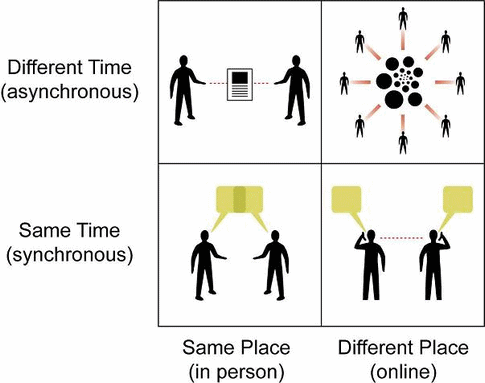
(Smith, 2012, Synchronous and Asynchronous Communication)


Synchronous Tools in Online Learning Scenarios
Online Trends and Advanced Tools

By Prof. Jonathan Acuña Solano
Wednesday, November 4, 2015
Twitter: @jonacuso
Post 204

One of the most inconvenient things that college students have is to find time to get together with partners to develop course projects. Synchronous tools allow learners in a college setting to work together at the same time while in different locations within the same city, country, or afar. “Synchronous communication is any form of live communication that demands all parties involved in a conversation be present at the same time. This forces the conversation to occur when both parties are available and may inconvenience schedules of one or both of the participants” (Smith, 2012). For an online course, synchronous tools provide support for students to discuss, share, and collaborate simultaneously with or without the assistance of a professor. For all these reasons, as an online teacher, it is important to recognize the benefits, challenges, and what is needed on your online course prior to selecting synchronous tools. A couple of synchronous tools I have often used and encourage students to use are: Google Docs along with Google Talk and AnyMeeting.

When one gets to talk about the benefits we can get out of Google Docs, it is important to highlight how it can be synchronously effective for learners. What if students need to get together for a project? Do you –as an instructor- want them to get together? If the answer is yes, how about having them get together virtually? Google Docs, no matter what you are developing (a report, equations, a presentation, etc.), all of that can be done on it. 1) Students can develop presentation jointly even while having a conversation simultaneously about what needs to be included or excluded. 2) Learners can be working on a report, e.g., and in different parts of it synchronously and sharing feedback for one another either while talking or chatting. And 3) What about brainstorming? It can be a great place to share ideas and keep a record of them while conversing or chatting at the same time. Google Docs is a great synchronous tool to be implemented and used with or among students. “Anyone who is in the market for word processing software should take a look at Google Docs. Some may be uncomfortable relying on web-based software. However, with collaboration tools and online storage, Google Docs will appeal to Word users who work on multiple computers or who collaborate with others” (Marshall, n.d.), and who lack time to get together with peers to plan presentations, write reports, and so on.

Though Google Docs along with Google Talk is a great tool, AnyMeeting.Com is a free online application when more than two people need to work simultaneously. Google Docs is a great tool to work on a one to one basis, but if more people need to collaborate, AnyMeeting is a better option. “Users can host an unlimited number of webinars, with up to 200 users per session. It is easy to easy to use, so even first-time hosts will be able to easily find their way around the software” (Warren, n.d.). As a teacher then, a) I can create a virtual classroom to meet with three or more students with or without the use of webcams, something Skype cannot do unless you pay for that service. b) I can mute or promote speakers so they can take control of the class in case I want them to voice opinions or comment. c) I can even show them anything I have on my computer desktop including videos that they can actually see and hear. If students are taught to use tools like this, life can go on though they may be miles apart or lacking the time to commute to have a conversation about a college project.

Synchronous tools are indeed important to be shared and promoted among students who cannot get together due to their tight schedules. Tools like Google Docs and AnyMeeting favor cooperative learning among learners who have a difficulty in moving from one place to another. And even if they may be out of the country, they can join meetings and participate actively. And what if the instructor needs to be away, too? He can create a virtual classroom for all of them to continue with instruction and fostering learning.

References


Marshall, J. (n.d.). Google Docs Online Word Processing Software. Retrieved from About.Com: http://wordprocessing.about.com/od/choosingsoftware/gr/writerly.htm
Smith, R. (2012, May 23). Synchronous vs Asynchronous Communication and why it matters to you as a doctor. Retrieved from iMedicalApps: http://www.imedicalapps.com/2012/05/synchronous-asynchronous-communication/
Warren, G. (n.d.). AnyMeeting Review - Free Web Conferencing Tool. Retrieved from About.Com: http://mobileoffice.about.com/od/conferencing-and-collaboration/fr/freebinar-review.htm


Wednesday, November 04, 2015


Community of Practice: An Asynchronous Tools Reflection

#LTTO, Hybrid and Blended Learning, VLE, VLEs 0 comments


Community of Practice
An Asynchronous Tools Reflection

By Prof. Jonathan Acuña Solano
Sunday, November 1, 2015
Twitter: @jonacuso
Post 203

          As one explores asynchronous tools for one’s online course, it is way essential to evaluate how these tools can affect the learning environment one is intending to create for one’s class. As an online or blended instructor, it is necessary to think of the following: the most challenging feature an asynchronous tool can have, the greatest benefit one and one’s class can get out of it, and any question one may have regarding the use of asynchronous tools prior its launching in a course one is teaching.


·         What do you feel is the most challenging feature of asynchronous tools?

When confronted with trying to give an answer to this question, I can barely think of an appropriate answer. The point I am trying to make in terms of challenges can be directly connected to the instructor or to the learner. At the beginning the neophyte teacher can find him/herself in a dead-on street if help is not asked from some experienced users of the tool(s) s/he wants to use in his/her online or hybrid course. As soon as this shocking experience is over and expertise and confidence are gained, the instructor is even ready to help students use the desired tool.

To put it simple, teachers can find it difficult at the beginning, but as soon as they get the knack of how something is used, they are on the go. As for students, who are more technologically oriented, the transition to start using a new tool can be just a matter of a short lapse. However, do bear in mind that there may be learners who are not digital natives and who need extra coaching to use the tool properly.


·         What do you feel is the greatest benefit of these tools?

Asynchronous tools benefit today’s learners beyond what can be really measured. Firstly, tools like this provide a certain kind of freedom that working students cannot experienced due to their tight schedules, mainly connected to their jobs. With asynchronous tools, they can find some room in their busy agendas to do what is requested in the course chronogram. Secondly, it terms of m-Learning, these tools offer them the chance of working on their assignments while commuting back and forth from home to work. With their mobile devices they are also aligned with the course content and with the teacher’s feedback and new materials.

With tools like this, we need to stop being skeptical that blended and mobile learning cannot be ideal ways of earning a degree by thousands of individuals on this planet. Asynchronous tools provided by the course instructor is the last ingredient needed to help all these students to get a university degree or additional training for their working life. After being in this position before as a student in an online environment attaining two different associate degrees as a complement to my current job in education, I am certain the it is possible to teach asynchronously and learn deeply in this particular educational setting.


·         What questions do you still have about using asynchronous tools in your online course?

When asked the above question, I must admit that I have already overcome my initial skepticism of online, hybrid, and blended learning. I feel certain that education can be attained in different ways, and that our technological societies and citizens are looking for extra alternatives that can allow them to work, have a family, enjoy their social life, and also get a degree in a higher education institution.


The use of all these asynchronous tools connected to an LMS platform can be the long-awaited answer that many individual in our home countries have been waiting for. Why to stop learning and learners who are craving to continue developing themselves professionally, if online, hybrid, and blended education can satisfy the education needs that many individuals have today.


Sunday, November 01, 2015


Older Posts Home
Subscribe to: Posts (Atom)

    Blog Stats

    Blog Stats
    Sunday, June 14, 2026

    Reflective Online Teaching

    Reflective Online Teaching
    Since 2010

    Costa Rica

    Costa Rica
    My Home Country

    +550 Posts and counting

    +550 Posts and counting

    TESOL Certified Instructor

    TESOL Certified Instructor

    Certified Virtual Instructor

    Certified Virtual Instructor

    PD Talks & NCTE-Costa Rica

    PD Talks & NCTE-Costa Rica

    Copyscape

    Protected by Copyscape

    Blog Archive

    • ▼  2026 (59)
      • ▼  June (4)
        • Beyond the Coursebook: Adapting ELT Materials for ...
        • Between the Fantastic and the Archetypal: A Todoro...
        • Error Correction and Learner Anxiety in Communicat...
        • From Epic Return to Existential Dissatisfaction: A...
      • ►  May (7)
      • ►  April (6)
      • ►  March (15)
      • ►  February (15)
      • ►  January (12)
    • ►  2025 (81)
      • ►  December (10)
      • ►  November (12)
      • ►  October (11)
      • ►  September (10)
      • ►  August (8)
      • ►  July (7)
      • ►  June (6)
      • ►  May (3)
      • ►  April (4)
      • ►  March (6)
      • ►  February (2)
      • ►  January (2)
    • ►  2024 (28)
      • ►  December (3)
      • ►  November (2)
      • ►  October (4)
      • ►  September (4)
      • ►  August (5)
      • ►  July (3)
      • ►  June (2)
      • ►  May (2)
      • ►  April (3)
    • ►  2023 (6)
      • ►  September (1)
      • ►  August (5)
    • ►  2022 (1)
      • ►  July (1)
    • ►  2020 (54)
      • ►  November (4)
      • ►  October (7)
      • ►  September (11)
      • ►  August (15)
      • ►  July (10)
      • ►  April (2)
      • ►  March (5)
    • ►  2019 (13)
      • ►  August (5)
      • ►  July (8)
    • ►  2018 (11)
      • ►  June (2)
      • ►  May (7)
      • ►  April (2)
    • ►  2017 (6)
      • ►  May (2)
      • ►  April (2)
      • ►  January (2)
    • ►  2016 (101)
      • ►  November (4)
      • ►  October (7)
      • ►  September (10)
      • ►  August (4)
      • ►  May (22)
      • ►  April (17)
      • ►  March (21)
      • ►  February (14)
      • ►  January (2)
    • ►  2015 (53)
      • ►  November (5)
      • ►  October (13)
      • ►  August (4)
      • ►  July (8)
      • ►  June (5)
      • ►  May (14)
      • ►  April (4)
    • ►  2014 (40)
      • ►  October (5)
      • ►  September (11)
      • ►  August (4)
      • ►  June (3)
      • ►  May (8)
      • ►  April (5)
      • ►  February (1)
      • ►  January (3)
    • ►  2013 (46)
      • ►  December (1)
      • ►  November (1)
      • ►  October (3)
      • ►  September (5)
      • ►  August (6)
      • ►  July (7)
      • ►  June (6)
      • ►  May (7)
      • ►  April (1)
      • ►  March (4)
      • ►  February (3)
      • ►  January (2)
    • ►  2012 (17)
      • ►  December (3)
      • ►  November (4)
      • ►  October (4)
      • ►  September (6)
    • ►  2011 (5)
      • ►  September (2)
      • ►  August (2)
      • ►  January (1)
    • ►  2010 (46)
      • ►  December (9)
      • ►  November (14)
      • ►  October (3)
      • ►  March (4)
      • ►  February (8)
      • ►  January (8)

    Labels

    • #EdChat (8)
    • #LTTO (14)
    • A Princess of Mars (1)
    • A Tale of Two Cities (1)
    • A Woman fo No Importance (1)
    • A1 Learners (1)
    • ABLA (9)
    • Academic Integrity (1)
    • Academic Research (9)
    • Adaptive Expertise (1)
    • Adaptive Learning (1)
    • ADDIE Model (7)
    • Adult Education (2)
    • Adult ELT (1)
    • Adult Learners (3)
    • Adult Learning (1)
    • Adult Online Learning (1)
    • Adventure Fiction (1)
    • Aesthetics (1)
    • Affective Filter (3)
    • Afro-Caribbean Lore (1)
    • Agile Professional Development (1)
    • AI Detection (1)
    • AI Ethics (1)
    • AI in ELT (1)
    • Alberto Delgado Alvarez (1)
    • Aldous Huxley (1)
    • Aldus Huxley (1)
    • Alexander Luria (5)
    • Algorithmic Bias (2)
    • Alienation (1)
    • Ambiguity (1)
    • Analytical Thinking (1)
    • Anansi (1)
    • Ancient Astronaut Theory (1)
    • Ancient Mysteries (1)
    • Andragogy (5)
    • Andy Curtis (1)
    • Angelology (2)
    • Animal Consciousness (1)
    • Animal-Machine (1)
    • António Vieira (1)
    • Aouda (1)
    • Apps for Education (1)
    • Archaeology (1)
    • Archetypal Analysis (1)
    • Archetypes (1)
    • Archimedes (1)
    • Aristocracy (1)
    • Arsène Lupin (1)
    • Art and Technology (1)
    • Artificial Intelligence (3)
    • Artistic Philosophy in ELT (1)
    • Assessment (12)
    • Assessment in Action (2)
    • Assessment Literacy (1)
    • Assessment Practices (6)
    • ASSURE (1)
    • Asynchronous Tools (2)
    • Attention Span (1)
    • Augustine (1)
    • Aural/oral skills (1)
    • Authenticity (1)
    • autonomous learning (1)
    • Autonomy (1)
    • Bamboo (1)
    • Baroque Thought (1)
    • Barthesian Analysis (6)
    • Behavior (1)
    • Being vs. Having (1)
    • Benjamin Button (1)
    • Bergson (1)
    • Betrayal (2)
    • Bettelheim (1)
    • Biblical Monotheism (1)
    • Biblical Text Analysis (1)
    • Big Data (6)
    • Bilingualism (1)
    • Biopolitics (1)
    • Blended Learning (1)
    • BlendIt Course (8)
    • Blind Faith (1)
    • Blind Observations (1)
    • Bloom's Taxonomy (5)
    • BNCs (9)
    • Board Work (2)
    • Book Critique (2)
    • Book of Enoch (1)
    • Book of Job (1)
    • Book of Revelation (1)
    • Bookmarking Sites (1)
    • Bourgeois Society (1)
    • Brave New World (1)
    • Brazilian Literature (4)
    • Brazilian Romanticism (2)
    • Breakout Rooms (3)
    • British Council (19)
    • Brotherhood (1)
    • Bureaucracy (3)
    • Burnout Prevention (1)
    • Cain (1)
    • Carl Jung (3)
    • Case Study (4)
    • Catalog of Rubrics (1)
    • Catholic Storytelling (1)
    • CEF (2)
    • CEFR (1)
    • CEFR-Aligned Assessment (1)
    • Centro Universitario de Desarrollo Intelectual (1)
    • Character Analysis (3)
    • Character Development (1)
    • Characterization (3)
    • Charles Dickens (1)
    • Christian Demonology (1)
    • Civil Obedience (1)
    • Civilization (1)
    • Classical Biography (1)
    • Classical Literature (1)
    • Classroom Interaction (2)
    • Classroom Management (8)
    • Classroom Organization (1)
    • Classroom Practice (1)
    • Classroom Routines (1)
    • Cloud Reader (1)
    • CLT (6)
    • Coaching (1)
    • Coaching in Teacher Classroom Observation (2)
    • Code of Ethics (1)
    • Cognition (1)
    • Cognitive Load (1)
    • Collaborative Learning (1)
    • Collectivism (1)
    • Colombian Poetry (1)
    • Color Motifs (1)
    • Communicating about Uncertainty (1)
    • Communicative Competence (4)
    • Communicative Language Teaching (7)
    • Communities of Practice (2)
    • Community of Practice (8)
    • Comparative Mythology (1)
    • Comparative Religion (2)
    • Comparative Studies (1)
    • Competency-Based Learning (9)
    • Conformity (2)
    • Conformity Pressure (1)
    • Connectivism (1)
    • Conscience (1)
    • Constructive Alignment (1)
    • Constructivism (1)
    • Contemporary Aesthetics (1)
    • Contemporary Short Fiction (1)
    • Content Assimilation (1)
    • Content Design (1)
    • Cooperative Learning (2)
    • CoP (3)
    • Corrective Feedback (4)
    • Cosmology (1)
    • Costa Rica (2)
    • Costa Rican Literature (1)
    • Course Project (2)
    • Coursebook Adaptation (1)
    • Creative Agility (1)
    • Creativity (1)
    • Critical reflection (1)
    • critical skills (1)
    • Critical Thinking (1)
    • Critical Thinking Skills (2)
    • Cultural Allegory (1)
    • Cultural Assimilation (1)
    • Cultural Centers (1)
    • Cultural responsiveness (1)
    • Culture (12)
    • Culture Framework (2)
    • Culture Teaching (8)
    • Curriculum Design (3)
    • Curriculum Development (6)
    • Custom eLearning (2)
    • Custom Training (1)
    • Dante Alighieri (2)
    • Dante Studies (2)
    • Darwinism (1)
    • Data Science (7)
    • Data-Driven Teaching (5)
    • Data-Informed Leadership (1)
    • David Fincher (1)
    • DDT (1)
    • Death (1)
    • Deborah Tannen (1)
    • Decadence (1)
    • Deductive Grammar Instruction (2)
    • Deep Ecology (1)
    • Dehumanization (1)
    • Demonology (2)
    • Demonology and Devil-Lore (2)
    • Demythologization (1)
    • Deontology (2)
    • Desire (3)
    • Determinism (1)
    • Developmental Feedback (1)
    • Dialogism (1)
    • Diane Larsen-Freeman (1)
    • Dictator (1)
    • Didactics (4)
    • Differentiation (3)
    • Digital Culture (1)
    • Digital Inequality (1)
    • Digital Pedagogy (2)
    • Digital Resources (1)
    • Dignity (1)
    • Dino Buzzati (1)
    • Discourse Analysis in ELT (1)
    • Distance Education (2)
    • Dreams (1)
    • Dualism (1)
    • Dysfunctional Families (1)
    • Dystopia (2)
    • Dystopian Fiction (1)
    • Dystopian Society (1)
    • E-Portfolios (1)
    • Eça de Queirós (9)
    • Eco-Criticism (1)
    • Edgar Rice Burroughs (2)
    • Education (1)
    • Education and Learning (34)
    • Education Policy (2)
    • Education Technologies (9)
    • Educational Evolution (1)
    • Educational Leadership (1)
    • Educational Philosophies (1)
    • EFL/ESL Activities (1)
    • El Clis de Sol (1)
    • eLearning (1)
    • Electracy (1)
    • ELF (1)
    • Elicitation (1)
    • ELL (17)
    • Elohim (3)
    • Elora Hary (1)
    • ELT (63)
    • ELT Conference (1)
    • ELT Institutions (1)
    • ELT Leadership (1)
    • ELT Methodology (1)
    • ELT Pedagogy (2)
    • ELT Professional Development (3)
    • ELT. Teacher Growth (1)
    • Emotional Intelligence (1)
    • Emotional Literacy (2)
    • Emotional Repression (1)
    • Empathy (1)
    • English Grammar (3)
    • English Language Teaching (13)
    • English Teaching (1)
    • Enkidu (1)
    • Environmental Destruction (1)
    • Environmental Philosophy (1)
    • Envy (1)
    • Epistemology (1)
    • Equity (1)
    • Eric Mazur (1)
    • Erich Fromm (4)
    • Error Correction (2)
    • Escape from Freedom (1)
    • Eschatology (1)
    • Esotericism (1)
    • ESP (2)
    • Ethical Inaction (1)
    • Ethical Judgment (1)
    • Ethical Judgments (1)
    • Ethical Leadership (1)
    • Ethical Sacrifice (1)
    • Ethics (46)
    • Ethics Analysis (2)
    • Ethics Education (1)
    • Ethics of Care (1)
    • Etiological Storytelling (1)
    • Evaluating Digital Tools (1)
    • Evaluation (4)
    • Evil (1)
    • Evolution (1)
    • Executives' School (9)
    • Existentialism (1)
    • Ezekiel (1)
    • F. Scott Fitzgerald (1)
    • Fairy Tales (2)
    • Faivre (1)
    • False Positives (1)
    • Fantastic (2)
    • Fatalism (2)
    • Fear (1)
    • Feedback (5)
    • Female Identity (1)
    • Flipped Classroom (1)
    • Flipped Learning (1)
    • Focus on Form (1)
    • Folklore (1)
    • Formative Assessment (5)
    • Forums (1)
    • Fossilization (1)
    • Frames-Based Teaching (1)
    • Framing in Discourse (1)
    • Frankenstein (1)
    • Franz Kafka (1)
    • Freedom (1)
    • French Literature (2)
    • Freudian Analysis (3)
    • From theory to practice (2)
    • Frommian Analysis (2)
    • Fulfillment (1)
    • Future for Education? (2)
    • Gabriel Escorcia Gravini (1)
    • Gamification (1)
    • Genesis (1)
    • George Orwell (1)
    • George Sand (1)
    • Global Competence (1)
    • Global Ethics (7)
    • Gnosticism (1)
    • Gothic Literature (1)
    • Gothicism (1)
    • Grading Ranges (1)
    • Grammar (3)
    • Greed (1)
    • Group Dynamics (2)
    • Group Work (2)
    • Guest Author (1)
    • Guided Practice (2)
    • H. G. Wells (1)
    • H.P. Lovecraft (3)
    • Haiku (2)
    • Hanegraaff (1)
    • HD Brown (1)
    • Hebrew Mythology (1)
    • Hermeticism (2)
    • Hero’s Journey (1)
    • Hesitation (1)
    • Higher Education (49)
    • Higher Education Ethics (1)
    • Historical Context (1)
    • Historical–Biographical Criticism (1)
    • History (2)
    • Holistic Education (1)
    • Homer (1)
    • Homerton College Cambridge Course (2)
    • Hootcourse (1)
    • Horacio Quiroga (1)
    • Human Dignity (1)
    • Human Rights (1)
    • Human-Centered Narrative (1)
    • Human-Centered Pedagogy (1)
    • Humanistic Morality (1)
    • Humanity (1)
    • Hybrid and Blended Learning (61)
    • Hybrid In-person Teaching (1)
    • Hybrid Learning Models (1)
    • Identit (1)
    • Identity (2)
    • Ideology (3)
    • Idioms (1)
    • Iktomi (1)
    • Imagery (2)
    • Inclusive Education (1)
    • Inclusive Pedagogy (2)
    • Independent Practice (1)
    • Indianism (1)
    • Indigenous Heroism (1)
    • Individuation (2)
    • Inductive Grammar Instruction (2)
    • Inferno XXXIII (1)
    • infographic (1)
    • Institutional Culture (1)
    • Institutional Improvement (1)
    • Institutional Memory (1)
    • Instruction-Giving (1)
    • Instructional Design (4)
    • Integration of Technology into Teaching (10)
    • Interaction (1)
    • Interaction Patterns (2)
    • Intercultural Awareness (1)
    • Interdisciplinary Inquiry (1)
    • Interlanguage (2)
    • Intertextuality (1)
    • Interventions in ELL (1)
    • Irony (4)
    • Isaac Asimov (1)
    • Issus (1)
    • Italian Literature (1)
    • Jacqueline Alves Souza (1)
    • Jacques de Molay (1)
    • Jacques Lacan (4)
    • James Knowles (1)
    • James Thurber (1)
    • Japanese Folklore (1)
    • Jehovah (1)
    • Jeremiah (1)
    • Jewish Apocalypticism (1)
    • Jewish Mysticism (1)
    • John Carter (1)
    • José de Alencar (2)
    • JotForm (1)
    • Journey to the Center of the Earth (1)
    • Jules Verne (3)
    • Jungian Analysis (9)
    • Just-in-Time Training (1)
    • Kabbalah (1)
    • Kahlil Gibran (2)
    • Kathleen M. Bailey (1)
    • Kazinczy (1)
    • Kindness (1)
    • King Arthur and his knights (1)
    • Kirkpatrick Model (15)
    • Knight Templars (1)
    • Knowledge (1)
    • Kurt Vonnegut (1)
    • La gran miseria humana (1)
    • La Insolación (1)
    • Lacan (1)
    • Lacanian Analysis (7)
    • Lacanian Psychoanalysis (1)
    • Language (1)
    • Language Competences (1)
    • Language Education (2)
    • Language Institutions (1)
    • Language Learning (15)
    • Language Series Comparative Analysis (1)
    • Language Teaching (9)
    • Latin American Literature (3)
    • Laureate Course Module 3 Teaching with Technology (19)
    • Laureate Educator (4)
    • Laureate Educator in the XXI Century (2)
    • Laureate Educator-Week 1 (1)
    • Laureate Educator-Week 2 (1)
    • Laureate Educator-Week 3 (1)
    • Le Drac (1)
    • Leadership (10)
    • Learner Agency (1)
    • Learner Anxiety (1)
    • Learner Attention (1)
    • learner autonomy (4)
    • Learner Confidence (1)
    • Learner Diversity (3)
    • Learner Engagement (1)
    • Learner Grouping (2)
    • Learner Uptake (1)
    • Learner-Centered Instruction (2)
    • Learner-Centered Pedagogy (1)
    • Learner-Centeredness (1)
    • Learning (8)
    • Learning Activities (1)
    • Learning Analytics (1)
    • Learning Objectives (2)
    • Learning Preferences (1)
    • Learning Styles (1)
    • Learning Technologies (1)
    • Leopoldo Lugones (1)
    • Les Demoiselles d’Avignon. Pablo Picasso (1)
    • Lesson Closure (1)
    • Lesson Design (2)
    • Lesson Openings (1)
    • Lesson Planning (6)
    • Lev Vygotsky (4)
    • Libraries (1)
    • Life is a Dream (1)
    • Life Stories (1)
    • Linguistics (2)
    • Listening (1)
    • Literary Analysis (8)
    • Literary Criticism (27)
    • Literary Ethics (1)
    • Literary Psychology (1)
    • Literature (36)
    • LMS (6)
    • Lord’s Prayer (1)
    • LOTI Profile (5)
    • Love (2)
    • Lycurgus (1)
    • Machado de Assis (2)
    • Machiavellian Narration (1)
    • Mãe (1)
    • Magón (1)
    • MakerSpace (1)
    • Manuel González Zeledón (1)
    • Marcel Duchamp (6)
    • Marcellus (1)
    • Marxist Literary Approach (1)
    • Mary Shelly (1)
    • Materials Design (1)
    • Materials Development (1)
    • Maurice Leblanc (1)
    • Meaning of Justice (1)
    • Melodrama (1)
    • Mentalism (1)
    • Mentorship (1)
    • MEP (Ministerio de Educación Pública) (1)
    • Metacognition (3)
    • Metadata (1)
    • Metalinguistic Feedback (1)
    • Metaphor (1)
    • Metaphysics. Self-Mastery (1)
    • Methodology (3)
    • Micro-Ethics (1)
    • microcelebrities (1)
    • Microlearning (1)
    • Mimetic Desire (1)
    • Mind Maps (2)
    • Mindfulness (12)
    • Misogyny (1)
    • Mistake vs. Error (1)
    • Mixed-Ability Classes (1)
    • Mixed-Methods Research (4)
    • Mobile Learning (1)
    • Modeling in ELT (1)
    • Modern Realism (1)
    • Modernity (2)
    • Modular Learning (1)
    • Moncure Daniel Conway (5)
    • MOOCs (1)
    • Moodle (5)
    • Moral Agency (1)
    • Moral Allegory (1)
    • Moral Biography (1)
    • Moral Cannibalism (1)
    • Moral Education (1)
    • Moral Lesson (1)
    • Moral Philosophy (1)
    • Moral Responsibility (2)
    • Moral Theology (2)
    • Moral-Humanistic Criticism (1)
    • Morality (2)
    • Motherhood (1)
    • Motivation (3)
    • Multimedia Learning (1)
    • Music and Learning (1)
    • Myth (1)
    • Myth Interpretation (1)
    • Myth of Evil (1)
    • Mythic Narrative (1)
    • Mythological Archetypes (1)
    • Mythology (3)
    • Narrative (1)
    • Narrative Distance (1)
    • Narrative Empathy (1)
    • Narrative Irony (1)
    • Narrative pedagogy (1)
    • Narrative Structure (4)
    • Narrative Voice (1)
    • Nature (1)
    • Nature Spirits (1)
    • Necropolitics (1)
    • Needs Assessment (3)
    • Netiquette (1)
    • Network Community (1)
    • NGL (1)
    • Nicaraguan Literature (2)
    • Nicatesol (1)
    • Nietzsche (1)
    • Nive Events of Instruction (1)
    • Nonviolent Communication (6)
    • ñor Cornelio Cacheda (1)
    • Noticing (1)
    • Noticing Hypothesis (2)
    • Nouns in English (1)
    • Novice Teachers (3)
    • Nudos (1)
    • Objective Writing (1)
    • Odysseus (1)
    • OER (1)
    • Off-the-Shelf Learning (1)
    • Online Community (1)
    • Online EFL (1)
    • Online Instruction (55)
    • Online Language Teaching (2)
    • online learning (48)
    • Online Learning Programs (1)
    • Online Persona (9)
    • Online Program Design (1)
    • online teaching (8)
    • Online Teaching Approach (1)
    • Online Teaching Practices (72)
    • Oral Assessment (1)
    • Oral Communication (1)
    • Oral Skills (2)
    • Organizational Learning (1)
    • Orientalism (1)
    • Origins (1)
    • Oscar Wilde (1)
    • Output Hypothesis (1)
    • Padre Luis Coloma (1)
    • Paideia (1)
    • Paper.li (1)
    • Pasolini (1)
    • Passepartout (1)
    • Pater Noster (1)
    • Paul of Tarsus (1)
    • Paz a los muertos! (1)
    • PBL (1)
    • PD (2)
    • Peace to the Dead! (1)
    • Pedagogy (2)
    • Pedro Calderón de la Barca (1)
    • Peer Instruction (1)
    • Penitence (1)
    • Penny Ur (2)
    • Persona (1)
    • Personal Learning Networks (2)
    • Pessimism (1)
    • Phileas Fogg (1)
    • Philip K. Dick (1)
    • Philosophy (1)
    • Phonemics (4)
    • Phonetics (4)
    • Phonotactics (3)
    • Pilot Programs (1)
    • PLEs and PLNs for Lifelong Learning Competencies Week 1 (1)
    • Plot Analysis (1)
    • Plutarch (6)
    • Poetry (2)
    • Poetry Analysis (1)
    • Political Discourse (1)
    • Political Heroism (1)
    • Political Terminology (1)
    • Popol Vuh (1)
    • Population Control (1)
    • Portuguese Literature (3)
    • Portuguese Realism (1)
    • Postcolonialism (1)
    • Posthumanism (1)
    • Pride (1)
    • Procrustean Syndrome (1)
    • Produsage (1)
    • Produser (1)
    • Professional Capital (2)
    • Professional Competencies (1)
    • Professional Development (11)
    • Professional Growth (1)
    • Professional Identity (2)
    • Projec-Based Learning (1)
    • Promethean Myth (1)
    • Pronunciation (7)
    • Psychoanalysis (2)
    • Psychological Analysis (1)
    • Psychological Resilience (1)
    • Psychological Transformation (1)
    • Psychology (1)
    • Public Speaking (1)
    • Purgatorio XI (1)
    • Qualitative Research (4)
    • Quantitative Research (4)
    • Rapport (2)
    • rationality (1)
    • Reading (1)
    • Reading and Vocabulary (2)
    • Realism (2)
    • Recasts (1)
    • Reception Theory (1)
    • Recruitment (1)
    • Recycling in Education (1)
    • Reflective Communities (1)
    • Reflective Evaluation (2)
    • Reflective Journaling (5)
    • Reflective Practice (20)
    • Reflective Reading (1)
    • Reflective Teacher Communities (1)
    • Reflective Teacher Leadership (1)
    • Reflective Teaching (60)
    • Religion (1)
    • Religious Authority (1)
    • Religious Critique (1)
    • Religious Evolution (1)
    • Research (9)
    • Resilience (3)
    • Resource Adaptation (1)
    • Responsibility (1)
    • Return on Investment (1)
    • Richard Schmidt (2)
    • Risk Communication (1)
    • Robert Frost (1)
    • Robert Gagné (2)
    • ROI (1)
    • ROI in ELT (1)
    • Roland Barthes (3)
    • Roman Conquest (1)
    • Roman Offices (1)
    • Roman Republic (1)
    • RTC (1)
    • Ruben Puentedura (1)
    • Rubric-Based Planning (1)
    • Rubrics (3)
    • Samael (1)
    • SAMR Model (1)
    • Sanctity (1)
    • Scaffolding (2)
    • Schema (1)
    • Scholasticism (1)
    • Science Fiction (2)
    • Science Fiction Studies (1)
    • Scoop.it! (1)
    • Second Language Acquisition (5)
    • Secret Societies of the Middle Ages (1)
    • Self-Fulfilling Prophecy (1)
    • Semantic Change (1)
    • Semiotics (2)
    • Sentence Patterns (1)
    • Sermão de Santa Teresa (1)
    • Shadow (2)
    • Short Films (1)
    • Short Stories (4)
    • Short Story Analysis (1)
    • Simplicity (1)
    • Sioux Legends (3)
    • Sir Gareth (1)
    • Sir Gawain (1)
    • Sir Lancelot (1)
    • Sir Tristam (1)
    • Skepticism (1)
    • Sketchpads (1)
    • Skill Gap Analysis (1)
    • SLA (4)
    • Slavery in Brazil (1)
    • Social Agency (1)
    • Social Criticism (1)
    • Social Critique (1)
    • Social Language (3)
    • Social Media (29)
    • Social Networking in Education (3)
    • Social Perception (1)
    • Social Satire (1)
    • Social Transformation (1)
    • Son of Man (1)
    • Sparta (1)
    • Speaking (1)
    • Speaking Scenarios (1)
    • Stephen Krashen (1)
    • Sticky Curriculum (1)
    • Storytelling (1)
    • Strategies for online teaching (2)
    • Student Agency (1)
    • Student Assessment (1)
    • Student Engagement (1)
    • Student Interest (3)
    • Student Motivation (2)
    • Student Talk Time (1)
    • Student Tips (2)
    • Subjectivity (1)
    • Sumerian (1)
    • Summative Assessment (2)
    • Supernatural (1)
    • Supernaturalism (1)
    • Supervision (1)
    • Sustainability (2)
    • Symbolic Philosophy (1)
    • Symbolism (4)
    • Synchronous Online Teaching (1)
    • Syntax (2)
    • Syracuse (1)
    • Task-Based Instruction (1)
    • Task-Based Language Teaching (1)
    • Task-Based Learning (1)
    • TBI (1)
    • TBLT (3)
    • Teacher Agency (3)
    • Teacher Cognition (1)
    • Teacher Development (24)
    • Teacher Education (1)
    • Teacher Evaluation (2)
    • Teacher Feedback (2)
    • Teacher Identity (2)
    • Teacher Inquiry (1)
    • Teacher Mentoring (2)
    • Teacher Mentorship (1)
    • Teacher Observation (1)
    • Teacher Professional Development (2)
    • Teacher Reflection (2)
    • Teacher Training (5)
    • Teacher Well-being (4)
    • Teacher Well-Being. Kirkpatrick Model (1)
    • Teacher–Student Relationships (1)
    • Teaching (47)
    • Teaching Adolescents (1)
    • Teaching Aids (1)
    • Teaching ePortfolio (1)
    • Teaching Grammar (2)
    • Teaching Models (1)
    • Teaching Online (9)
    • Teaching Philosophy (4)
    • Teaching Portfolio (1)
    • Teaching Practices (49)
    • Teaching Practicum (22)
    • Teaching Presence (2)
    • Teaching Styles (8)
    • Teaching Tips (9)
    • Teaching With Technology (4)
    • Teaching With Technology-Week 1 (1)
    • Teaching With Technology-Week 2 (1)
    • Teaching With Technology-Week 3 (2)
    • Teaching With Technology-Week 4 (4)
    • Teaching With Technology-Week 5 (3)
    • Teaching With Technology-Week 6 (2)
    • Teaching With Technology-Week 7 (3)
    • Teaching With Technology-Week 8 (2)
    • Teaching With Technology-Week 9 (1)
    • Tech Tip (5)
    • Technocriticism (1)
    • Technological Assessment (2)
    • Technology Use Tips (1)
    • TED (1)
    • Templars (1)
    • Temporal Paradox (1)
    • Temporality (1)
    • Testing (1)
    • The Art of Loving (1)
    • The Assassins (1)
    • The Book of Proverbs (1)
    • The Butterfly Circus (1)
    • The Cats of Ulthar (1)
    • The Data Scientist (5)
    • The Epic of Gilgamish (1)
    • The Gods of Mars (1)
    • The Kybalion (2)
    • The Loincloth (1)
    • The New Normal (1)
    • The Noticing Hypothesis (2)
    • The Outsider (1)
    • The Prophet (2)
    • The Real (1)
    • The Road Not Take (1)
    • The Skull (1)
    • The Time Machine (1)
    • Theater Criticism (1)
    • Themistocles (1)
    • Theophoric Names (1)
    • Theseus (1)
    • Thomas Keightley (2)
    • Thomistic Ethics (2)
    • Thomistic Grace (1)
    • Timing of Correction (1)
    • Todorov (1)
    • Tolkien (1)
    • Transformation (1)
    • Trickster (1)
    • Trinity (1)
    • Turnitin (1)
    • Tzvetan Todorov (1)
    • UCC (1)
    • Ugarit (1)
    • Ugolino (1)
    • Universidad Mariano Gálvez (2)
    • Unreliable Narration (1)
    • Unreliable Narrator (1)
    • Utilitarianism (2)
    • Vengeance (1)
    • Videoconferencing Platforms (1)
    • Virtual Classroom Features (1)
    • Virtual Classroom Management (1)
    • Virtual Classrooms (1)
    • Virtual Learning Environments (8)
    • Virtual Teaching (5)
    • Virtualized Teaching (1)
    • Virtue (1)
    • Visual Literacy (1)
    • Visual Scaffolding (1)
    • VLE (47)
    • VLEs (38)
    • Vocabulary learning (10)
    • WAS (14)
    • Wealth (1)
    • Web 2.0 (4)
    • Web search engine options (1)
    • Web Tools (6)
    • WebQuests (1)
    • Western Esotericism (1)
    • Western Mysticism (1)
    • Wilbert Salgado (12)
    • William Elliot Griffis (1)
    • Willingness to Communicate (1)
    • Working Adult Student (5)
    • Workplace Dynamics (1)
    • writing (2)
    • Writing Skills (1)
    • Yahweh (1)
    • Yzur (1)
    • Zecharia Sitchin (1)
    • ZPD (1)

Copyright © All Rights Reserved. Reflective Online Teaching | Converted into Blogger Templates by Theme Craft