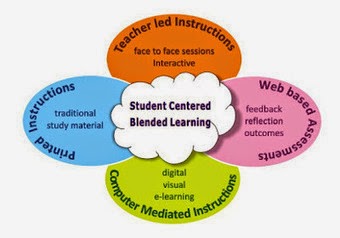
A Student-Centered Learning
Activity in Literature
Student-centered learning requires an
instructor to become more of a guide that helps support student knowledge
building and provides ample chances for learners to become autonomous. In spite
of the traditional teacher role of controlling the entire learning process, the
instructor must give room for students to take control of their learning in
his/her course. Yet it is important for instructors to maintain some control in
the design and development of the student-centered lessons, assignments, and
activities to guarantee learner autonomy.
Having in mind this teaching and
learning philosophy, let us take a look at an activity designed for an
Introduction to Literature course in the ELT major at Universidad Latina in
Costa Rica that endorses autonomous and blended learning.
Week
#11
American
Literature / 19th Century American Poets: Walt Whitman

Walt Whitman is praised for being, according to many
literary scholars, the best 19th Century poet in the United States
and the best poetic representative of the Transcendentalists. In his poetry,
Whitman addressed many different types of themes and wrote with a great array
of personas and moods.
Your task is to read two pieces of poetry by Whitman
and explain what message is being conveyed by the poem persona.
1.
One’s Self I Sing [page 14]
2.
I Hearn America Singing [page 33]
Save your homework as a
word or pdf document in this way: lastname_first
name initial_Whitman01.doc [Ex. Acuña_J_Whitman01.doc].
Your homework needs to be
published by [day], [month 00] by [time of day]. After that time you won’t be
allowed to upload any document.
Additional Resources:
|
Traditionally, in a F2F class students
and the instructor will discuss Whitman’s ars poetica and the literary movement
he belongs to, and the teacher will provide students with his formalistic
or/and historical/biographical approach interpretation on the selected pieces
of poetry. Then, students will probably be asked about the same poems on quizzes
or mid-term examinations, and they will possibly end up reproducing the very
same discourse they heard in class without really exercising their critical
thinking and learner autonomy.

Although in my particular Intro to Lit
course there is a class where Whitman’s ars poetica is indeed presented to the
students and discussed for them to understand his literary movement and his
historical period, they are encouraged to discuss among themselves and consult
additional online resources to find a way to validate their poetic
interpretations rather than to “replicate the same discourse they were exposed
to in class.” And that is basically what this activity intends to do by
following the structure in which it has been phrased following a IBP
(Internet-Based Project) and PBL (Project-Based Learning) model.
Proposed IBP / PBL Structure
|
1. Week
of the term
2. Theme
or topic identification
3. Introduction
to reading task
4. The
task
5. Way
in which homework/project needs to be saved to be uploaded to the class LMS
6. Homework/project’s
deadline
7. Additional
resources
a. eBook
where to find the material for analysis
b. any
other valuable site for students
|
The usual literary analyses yielded by
students are a good reflection of their training in terms of critical thinking
and use of Internet sources to validate their interpretations. Additionally,
student self-reliance in their “own” analysis grows with the use of the IBL and
PBL learning philosophies to empower students to really attain autonomy in
their learning with the guidance of their instructor.

Folsom, E.
& Price, K. (n.d). The Walt Whitman Archive. Retrieved from http://www.whitmanarchive.org/
Whitman,
W. (2007). Leaves of Grass. Retrieved from Penn State University Site:

? To
fully comprehend the scope of this teaching reflections, it is highly advisable
that the following topics must be expanded further:
·
Autonomous Learning
·
Internet-Based Projects
·
Project-Based Learning
·
How to teach literature in online scenarios

|

Pronunciation
Development
|
|
Reading Skills
Development
|
|
Curated Topics Online
|
|
Article
published on Wednesday, May 7, 2014
How to quote this
blog entry:
Acuña,
J. (2014, May 7). A Student-Centered Learning Activity in Literature. Retrieved from
Reflective Online Teaching Website: http://reflective-online-teaching.blogspot.com/2014/05/a-student-centered-learning-activity-in.html

No comments:
Post a Comment